How Do I Calculate My NHS Annual Leave Entitlement?
Your NHS annual leave entitlement depends on three main factors: your length of service, your contracted hours, and the region where you work.
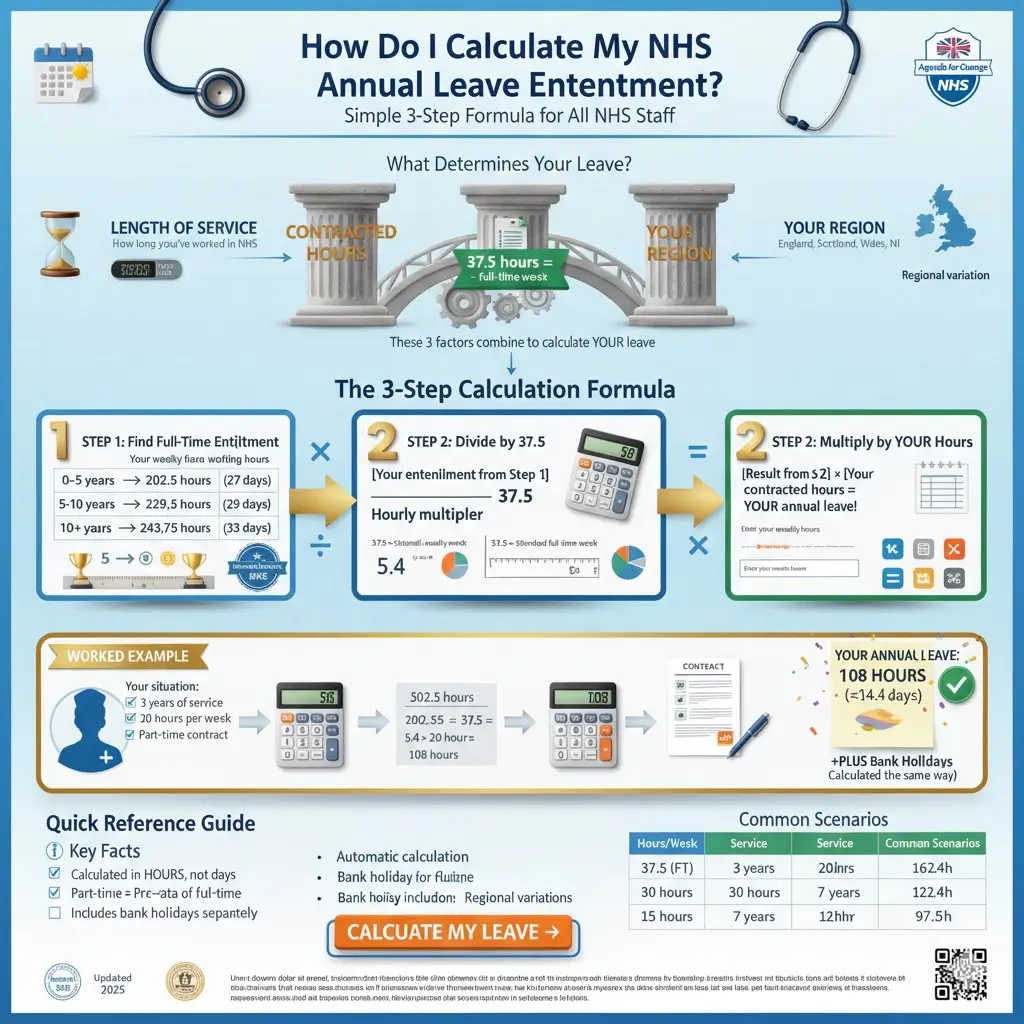
Under Agenda for Change, all NHS staff receive annual leave based on how long they have worked in the NHS. This is calculated in hours, not days, which makes it easier to work out part-time entitlements.
The basic formula is:
- Find your full-time entitlement based on years of service
- Divide by 37.5 (the standard full-time week)
- Multiply by your contracted hours
For example, if you work 20 hours per week with 3 years of service, your calculation would be:
- Full-time entitlement: 202.5 hours (27 days)
- Divided by 37.5 = 5.4
- Multiplied by 20 hours = 108 hours annual leave
You then add your bank holiday entitlement, calculated the same way.
How Much Annual Leave is Working for the NHS?
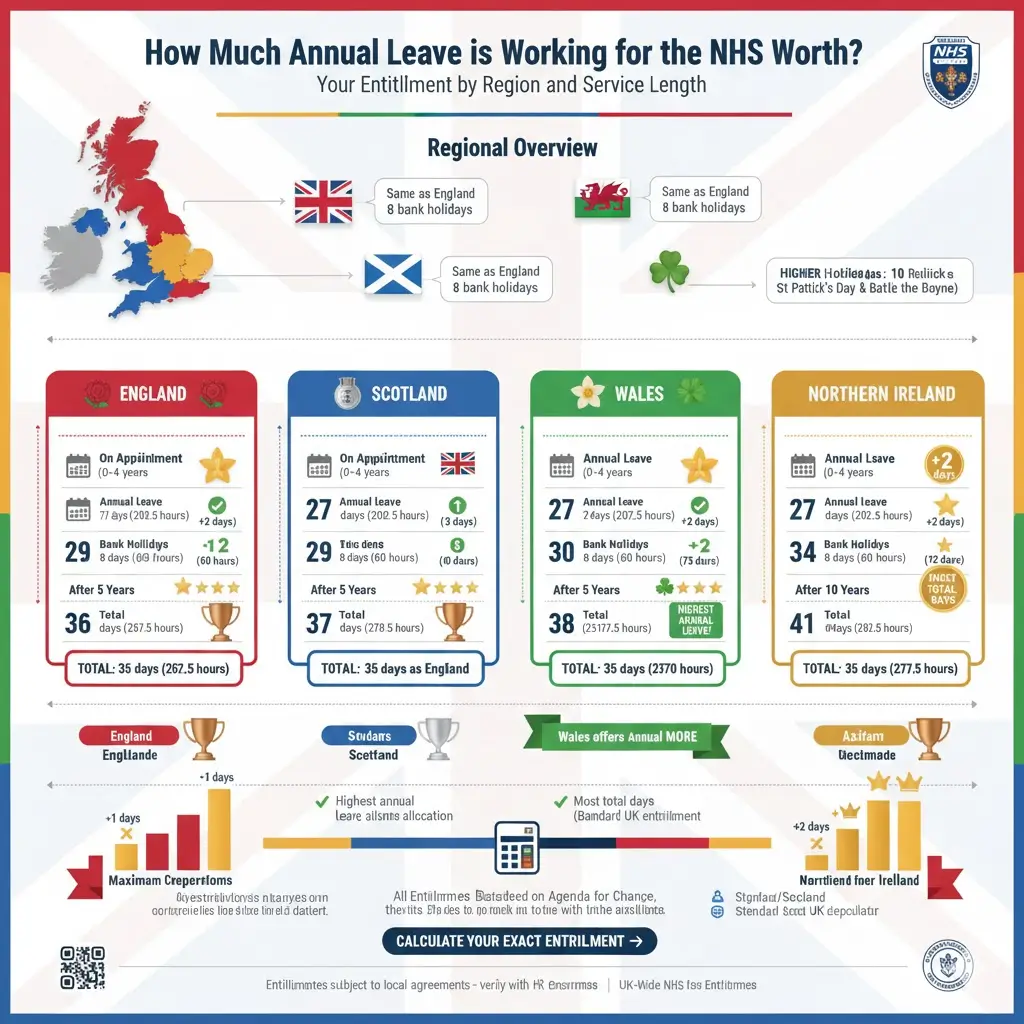
The amount of annual leave you receive depends on how long you have worked in the NHS. There are three service bands under Agenda for Change.
England and Scotland Entitlements
| Length of Service | Annual Leave | Bank Holidays | Total (Full-Time) |
| On appointment (0-4 years) | 27 days (202.5 hours) | 8 days (60 hours) | 35 days (262.5 hours) |
| After 5 years | 29 days (217.5 hours) | 8 days (60 hours) | 37 days (277.5 hours) |
| After 10 years | 33 days (247.5 hours) | 8 days (60 hours) | 41 days (307.5 hours) |
Wales Entitlements
NHS Wales staff receive slightly higher annual leave entitlements.
| Length of Service | Annual Leave | Bank Holidays | Total (Full-Time) |
| On appointment | 28 days (210 hours) | 8 days (60 hours) | 36 days (270 hours) |
| After 5 years | 30 days (225 hours) | 8 days (60 hours) | 38 days (285 hours) |
| After 10 years | 34 days (255 hours) | 8 days (60 hours) | 42 days (315 hours) |
Northern Ireland Entitlements
Northern Ireland has the same annual leave as England but with more bank holidays.
| Length of Service | Annual Leave | Bank Holidays | Total (Full-Time) |
| On appointment | 27 days (202.5 hours) | 10 days (75 hours) | 37 days (277.5 hours) |
| After 5 years | 29 days (217.5 hours) | 10 days (75 hours) | 39 days (292.5 hours) |
| After 10 years | 33 days (247.5 hours) | 10 days (75 hours) | 43 days (322.5 hours) |
The extra bank holidays in Northern Ireland include St Patrick’s Day on 17 March and the Battle of the Boyne on 12 July.
NHS Annual Leave After 5 Years
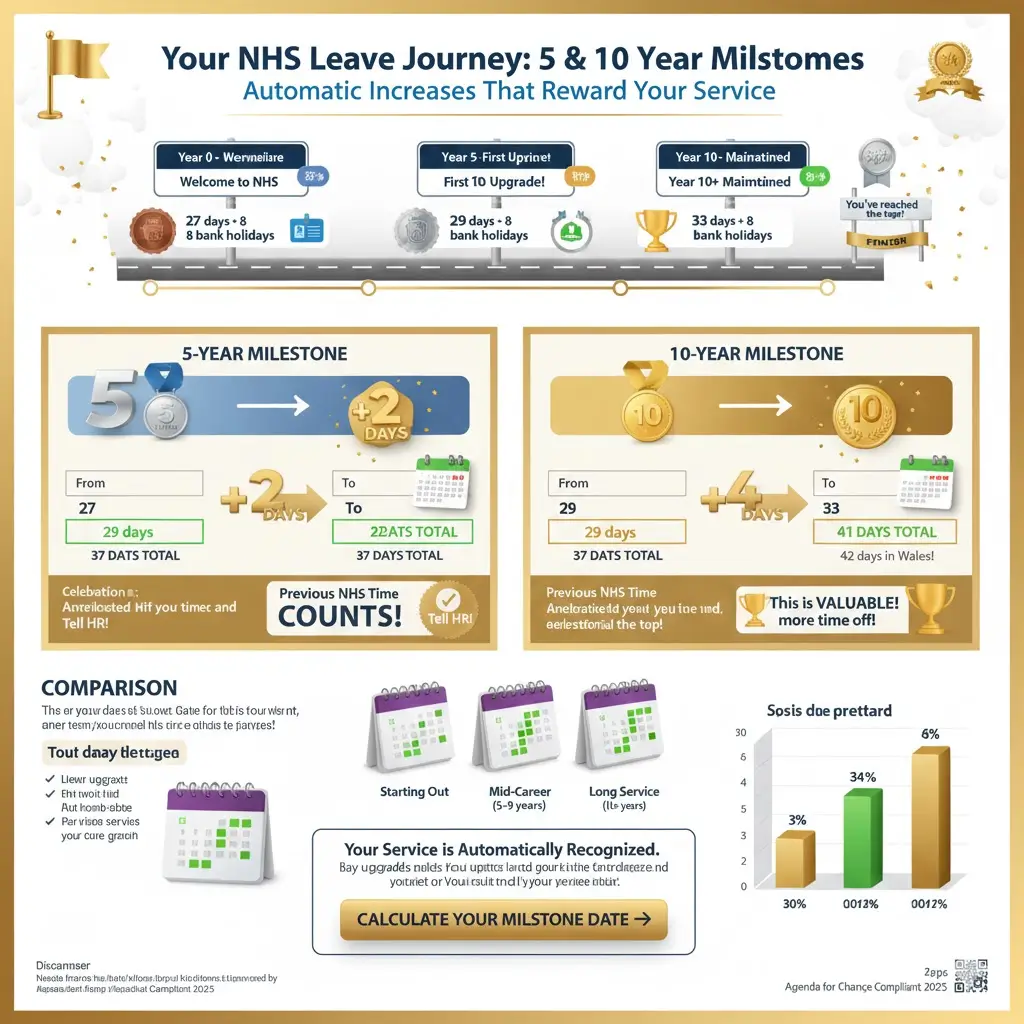
When you reach 5 years of continuous NHS service, your annual leave automatically increases from 27 days to 29 days. This is an extra 15 hours per year for full-time staff.
Your entitlement increases from the first day of the month following your 5th anniversary. For example, if you started on 15 June 2020, you would move to 29 days from 1 July 2025.
What counts towards 5 years’ service?
Previous NHS employment counts towards your service, even if you had a break. This is called reckonable service or aggregated service. It includes time worked at any NHS organisation across the UK.
If you have previous NHS service, make sure to tell your HR department when you join. You will need to provide proof, such as payslips or a reference from your previous NHS employer.
NHS Annual Leave After 10 Years
At 10 years of service, your entitlement increases again from 29 days to 33 days. This is an extra 30 hours per year for full-time staff.
Combined with bank holidays, this means a full-time NHS worker with 10 or more years of service receives up to 41 days of paid leave per year in England. In Wales, this rises to 42 days.
Many long-serving NHS staff are surprised by how valuable this benefit is. The extra days at the 10-year mark represent a significant improvement to your work-life balance.
Part-Time Annual Leave Calculation
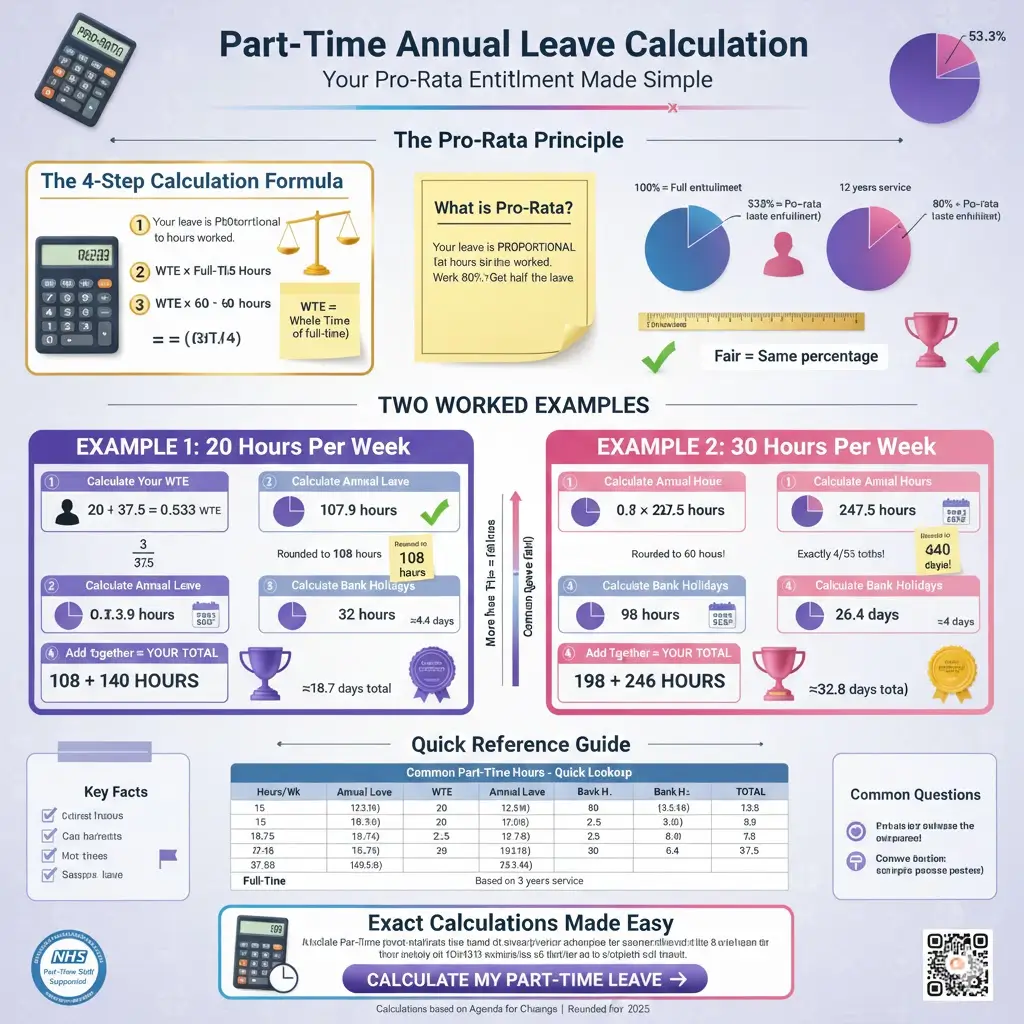
Part-time NHS staff receive annual leave calculated on a pro-rata basis. This means your leave is proportional to the hours you work compared to full-time hours.
The formula is:
(Your contracted hours ÷ 37.5) × Full-time entitlement = Your entitlement
Worked Example: 20 Hours Per Week
If you work 20 hours per week with 3 years of service:
Step 1:
Calculate your WTE (Whole Time Equivalent) 20 ÷ 37.5 = 0.533 WTE
Step 2:
Calculate annual leave 0.533 × 202.5 hours = 107.9 hours (rounded to 108 hours)
Step 3:
Calculate bank holiday entitlement 0.533 × 60 hours = 32 hours
Step 4:
Add together 108 + 32 = 140 hours total entitlement
Worked Example: 30 Hours Per Week
If you work 30 hours per week with 12 years of service:
Step 1:
Calculate WTE 30 ÷ 37.5 = 0.8 WTE
Step 2:
Calculate annual leave 0.8 × 247.5 hours = 198 hours
Step 3:
Calculate bank holiday entitlement 0.8 × 60 hours = 48 hours
Step 4:
Add together 198 + 48 = 246 hours total entitlement
How Can I Calculate Annual Leave?
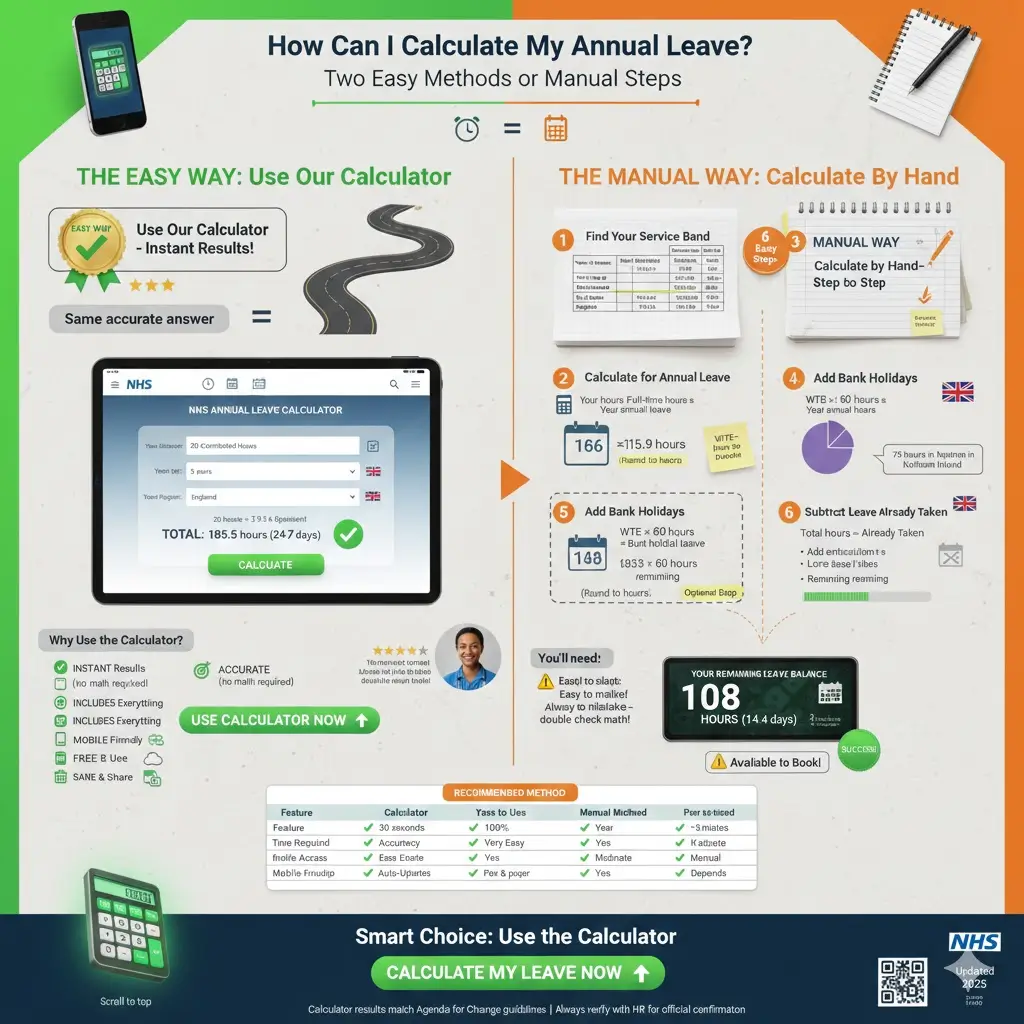
The easiest way to calculate your annual leave is to use our NHS Annual Leave Calculator at the top of this page. Simply enter your contracted hours, years of service, and region.
If you prefer to calculate manually, follow these steps:
Step 1:
Find your service band
- 0-4 years = 27 days (202.5 hours)
- 5-9 years = 29 days (217.5 hours)
- 10+ years = 33 days (247.5 hours)
Step 2:
Calculate your WTE. Your hours per week ÷ 37.5 = WTE
Step 3:
Multiply WTE × Full-time hours = Your annual leave in hours
Step 4:
Add bank holidays WTE × 60 hours (or 75 for Northern Ireland) = Bank holiday hours
Step 5:
Add any carryover or purchased leave
Step 6:
Subtract any leave already taken
The result is your remaining annual leave balance.
Mid-Year Starters and Leavers
If you start or leave partway through the leave year (April to March), your entitlement is calculated proportionally.
The 7-Day Joining Rule
There is an important rule about which month counts as your first full month:
- If you start in the first 7 days of a month, you receive full entitlement for that month
- If you start on or after the 8th of the month, that month is not included
Example: You start on 5 October. Because you started in the first 7 days, October counts as a full month. You receive entitlement for October through March (6 months).
Example: You start on 12 October. Because you started after the 7th, October does not count. You receive entitlement for November through March (5 months).
Calculating Part-Year Entitlement
For mid-year starters, the calculation is:
(Number of complete months ÷ 12) × Full year entitlement = Part-year entitlement
Or more precisely, using days:
(Days in employment ÷ 365) × Full year entitlement = Part-year entitlement
When Your Hours Change Mid-Year
If your contracted hours change during the leave year, your annual leave must be recalculated. This commonly happens when staff move from full-time to part-time or vice versa.
The calculation works by splitting the year into two parts:
Part 1: Months at old hours × Pro-rata entitlement at old hours
Part 2: Months at new hours × Pro-rata entitlement at new hours
Total: Part 1 + Part 2
Worked Example
You work full-time (37.5 hours) from April to September (6 months), then reduce to 22.5 hours from October to March (6 months). You have 7 years of service (29 days’ entitlement).
Part 1 (April-September at 37.5 hours): (37.5 ÷ 37.5) × 217.5 × (6 ÷ 12) = 108.75 hours
Part 2 (October-March at 22.5 hours): (22.5 ÷ 37.5) × 217.5 × (6 ÷ 12) = 65.25 hours
Total entitlement: 108.75 + 65.25 = 174 hours
Our calculator handles this automatically in the Mid-Year Change tab.
Scottish Reduced Working Week
NHS Scotland is reducing the standard working week for staff. This affects how annual leave is calculated.
| Date | Standard Week | Day Equivalent |
| Before April 2024 | 37.5 hours | 7.5 hours per day |
| From April 2024 | 37 hours | 7.4 hours per day |
| From April 2026 | 36 hours | 7.2 hours per day |
When calculating annual leave for Scottish NHS staff, you should use the appropriate standard week for your period. Our calculator automatically adjusts for this when you select Scotland as your region.
This means Scottish staff effectively get slightly more leave in terms of actual days off, even though the hours remain the same.
Bank Staff Annual Leave (12.07% Accrual)
Bank staff and zero-hours contract workers accrue annual leave differently. Instead of receiving a set entitlement, you build up leave based on hours worked.
The accrual rate is 12.07% of every hour worked. This percentage comes from the Working Time Regulations and represents the statutory minimum holiday entitlement.
How to calculate:
Total hours worked × 0.1207 = Hours of annual leave accrued
Example: You work 150 hours in a month.
150 × 0.1207 = 18.1 hours accrued
Some trusts pay this as “rolled-up holiday pay” included in your hourly rate. Others allow you to book time off using your accrued hours. Check with your HR department to understand how your trust handles Bank Staff leave.
Term-Time Workers
If you only work during school term times, your annual leave is calculated differently. This applies to staff who work a set number of weeks per year rather than year-round.
The formula is:
(Weeks worked per year ÷ 52.143) × (52.143 – weeks of leave entitlement) × Hours per week
This sounds complex, but it essentially calculates your leave as if you worked the full year, then adjusts for the weeks you actually work.
Example: You work 39 weeks per year at 37.5 hours with 5 years of service (29 days + 8 BH = 7.6 weeks).
39 ÷ (52.143 – 7.6) × 37.5 = 32.83 hours payable
This is paid on top of your contracted hours throughout the year.
Can I Carry Over NHS Annual Leave?
Yes, you can carry over annual leave to the next year, but there are limits.
Standard Carry Over
With your manager’s agreement, you can carry over up to 5 days (or one week’s contracted hours for part-time staff) to the following leave year. This must usually be taken within the first month of the new leave year.
What If You Have More to Carry Over?
In exceptional circumstances, your manager may allow you to carry over more than 5 days. However, this is not automatic and must be agreed in advance.
If you cannot take your leave because of work demands in the final three months of the leave year, you may be entitled to carry it over. Discuss this with your manager as early as possible.
Long-Term Sickness
If you are on long-term sick leave and cannot use your annual leave, you are entitled to carry over your statutory minimum of 20 days (pro rata for part-time). Any leave above this may be lost unless your trust has a more generous policy.
Maternity Leave
Staff on maternity leave can carry over their full untaken annual leave. This is because you continue to accrue leave throughout maternity leave, but cannot take it.
Are 20 Days of Annual Leave Legal in the UK?
Yes, 20 days is the absolute legal minimum in the UK under the Working Time Regulations. However, NHS staff on Agenda for Change receive significantly more than this.
The statutory minimum is 28 days, including bank holidays (5.6 weeks). NHS staff receive:
- Minimum 35 days (27 + 8 BH) on appointment
- Up to 41 days (33 + 8 BH) after 10 years
This makes NHS annual leave among the most generous in the UK public sector.
If you are ever asked to sell or give up leave, you must still retain at least 20 days to take as actual annual leave during the year. This is a legal requirement.
How to Calculate Annual Leave Amount
To quickly calculate your annual leave amount, you need three pieces of information:
- Your contracted hours per week
- Your years of NHS service
- The number of bank holidays in your leave period
Then use this formula:
(Your hours ÷ 37.5) × Base entitlement + (Your hours ÷ 37.5) × Bank holiday hours = Total
Quick Reference Table (Full-Time 37.5 Hours)
| Service | Annual Leave | Bank Hols | Total Hours |
| 0-4 years | 202.5 h | 60 h | 262.5 h |
| 5-9 years | 217.5 h | 60 h | 277.5 h |
| 10+ years | 247.5 h | 60 h | 307.5 h |
For part-time staff, multiply these figures by your WTE (hours ÷ 37.5).
Reckonable NHS Service
Your previous NHS employment counts towards your annual leave entitlement. This is true even if you had a gap between jobs.
What counts as reckonable service:
- Employment at any NHS Trust or Foundation Trust
- Employment at NHS England, ICBs, or CSUs
- Employment at Health Education England
- Employment at NHS Wales, NHS Scotland, or HSC Northern Ireland
What you need to prove it:
- P45 from previous NHS employer
- Payslips showing NHS employment
- Reference confirming dates of employment
- ESR (Electronic Staff Record) printout
When you join a new NHS employer, inform HR immediately about your previous service. This ensures you receive the correct annual leave entitlement from day one.
Buying and Selling Annual Leave
Some NHS trusts allow staff to buy or sell annual leave. This is usually offered once per year.
Buying Extra Leave
You can typically purchase up to one week of additional leave. The cost is deducted from your salary, spread across the year. This can be a cost-effective way to get more time off.
Selling Leave
You may be able to sell up to one week of annual leave back to your employer. This is paid at your basic rate and usually processed as a lump sum in April.
Important: You cannot sell leave that would bring you below 20 days for the year. This is the statutory minimum you must take.
Check your trust’s policy for details on buying and selling leave.
The NHS Leave Year
The standard NHS leave year runs from 1 April to 31 March. All entitlements, carry over, and calculations are based on this period.
Some trusts may allow you to have a different personal leave year based on your start date. Check with your HR department.
Bank Holidays 2025/26
England and Wales:
- Good Friday (18 April 2025)
- Easter Monday (21 April 2025)
- Early May Bank Holiday (5 May 2025)
- Spring Bank Holiday (26 May 2025)
- Summer Bank Holiday (25 August 2025)
- Christmas Day (25 December 2025)
- Boxing Day (26 December 2025)
- New Year’s Day (1 January 2026)
Scotland has the same number (8) but different dates, including 2nd January instead of Easter Monday.
Northern Ireland has 10 bank holidays, including St Patrick’s Day and the July holiday.
Frequently Asked Questions
How do I calculate my NHS annual leave entitlement?
Use the formula: (Your hours ÷ 37.5) × Full-time entitlement. For example, if you work 30 hours with 5 years of service, calculate 30 ÷ 37.5 = 0.8, then 0.8 × 217.5 = 174 hours. Add your pro-rata bank holidays for your total.
How much annual leave do NHS?
NHS staff receive 27 days plus 8 bank holidays on appointment (35 days total). This increases to 29 days after 5 years of service and 33 days after 10 years. Part-time staff receive this pro-rata based on their contracted hours.
How can I calculate annual leave?
The easiest way is to use our NHS Annual Leave Calculator. Enter your contracted hours, years of service, and region. The calculator automatically works out your entitlement, including bank holidays and any pro-rata adjustments.
Is 20 days of annual leave legal in the UK?
The legal minimum in the UK is 28 days, including bank holidays (5.6 weeks). However, 20 days is the minimum that must be taken as actual leave rather than being paid out or sold. NHS staff receive significantly more than this statutory minimum.
How to calculate the annual leave amount?
Multiply your full-time equivalent (hours ÷ 37.5) by the base entitlement for your service length (202.5, 217.5, or 247.5 hours). Then add your pro-rata bank holiday hours. Subtract any leave already taken from your remaining balance.
Can I carry over NHS annual leave?
Yes, with manager approval, you can carry over up to 5 days (one week’s contracted hours for part-time). Staff on long-term sick leave can carry over up to 20 days’ statutory entitlement. Maternity leave allows full carryover of untaken leave.
Does previous NHS service count towards my annual leave?
Yes, previous NHS employment counts as reckonable service, even with a gap between jobs. Provide proof to your HR department when you join to ensure you receive the correct entitlement immediately.
What happens if I start or leave mid-year?
Your entitlement is calculated proportionally. If you start in the first 7 days of a month, you receive full entitlement for that month. Starting on or after the 8th means that the month is not included in your calculation.
How does Bank Staff’s annual leave work?
Bank staff accrue 12.07% of every hour worked as annual leave. Multiply your total hours worked by 0.1207 to find your accrued leave. Some trusts include this in your hourly rate as rolled-up holiday pay.
What is the 7-day joining rule?
If you join in the first 7 days of a month, you receive annual leave for that complete month. If you join on or after the 8th, your entitlement starts from the following month.
Important Notes
Always check with your HR department or refer to your employment contract for your specific entitlement. Local policies may vary between trusts.
This calculator provides estimates based on standard Agenda for Change terms. It does not apply to doctors, dentists, or very senior managers who have different arrangements.
Annual leave calculations should be rounded up to the nearest half hour (0.5 decimal point).
For official calculations, your line manager is responsible for confirming your entitlement. Keep a copy of your calculation for your personal records.