NHS Pay Bands 2025/26: Complete Salary Guide for All Bands
Published January 20, 2026Updated January 29, 2026
The NHS pay bands for 2025/26 have been confirmed following the government’s acceptance of the NHS Pay Review Body recommendations. All Agenda for Change staff in England received a 3.6% pay award, effective from 1 April 2025. NHS salaries now range from £24,465 for Band 2 healthcare support workers to £125,637 for Band 9 directors of nursing.
This comprehensive guide covers every AfC pay band across England, Scotland, Wales and Northern Ireland, including annual salaries, hourly rates, pay progression rules, pension contributions and regional variations. Whether you’re a newly qualified nurse checking your Band 5 starting salary, a healthcare assistant on Band 2, or a ward manager on Band 7, this guide provides the official salary information published by NHS Employers for the 2025/26 financial year.
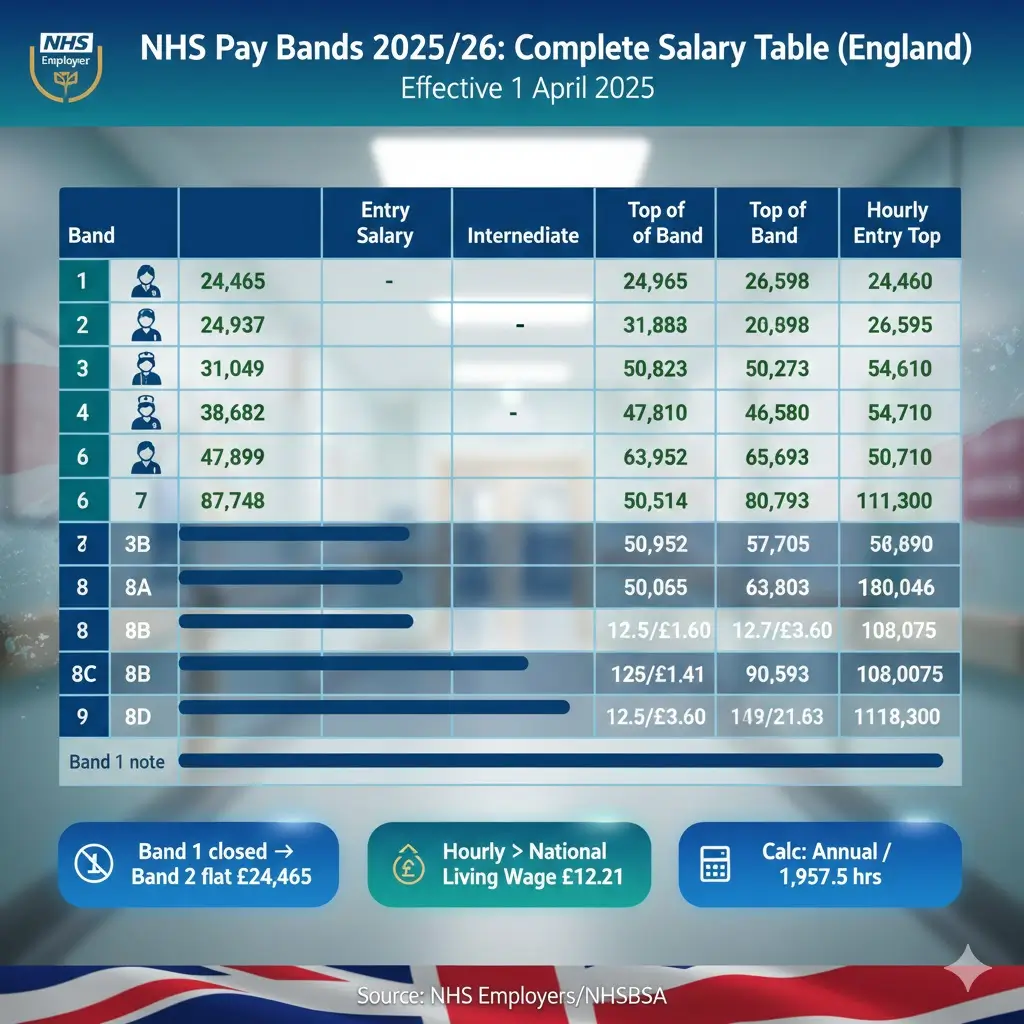
The table below shows the official Agenda for Change pay scales for 2025/26 in England, effective from 1 April 2025. These rates were published by NHS Employers following the confirmed pay award recommended by the independent NHS Pay Review Body.
Band
Entry Salary
Intermediate
Top of Band
Hourly Rate (Entry)
Hourly Rate (Top)
Band 1*
£24,465
—
£24,465
£12.51
£12.51
Band 2
£24,465
—
£24,465
£12.51
£12.51
Band 3
£24,937
—
£26,598
£12.75
£13.60
Band 4
£27,485
—
£30,162
£14.06
£15.43
Band 5
£31,049
£33,487
£37,796
£15.88
£19.33
Band 6
£38,682
£40,823
£46,580
£19.78
£23.82
Band 7
£47,810
£50,273
£54,710
£24.45
£27.98
Band 8a
£55,690
£58,487
£62,682
£28.48
£32.06
Band 8b
£64,455
£68,631
£74,896
£32.96
£38.30
Band 8c
£76,965
£81,652
£88,682
£39.36
£45.35
Band 8d
£91,342
£96,941
£105,337
£46.71
£53.87
Band 9
£109,179
£115,763
£125,637
£55.84
£64.25
*Band 1 is closed to new entrants. The remaining staff are paid at Band 2 rates.
Key points:
Band 2 operates as a flat rate with no incremental progression—entry and top of band are identical at £24,465
Hourly rates are calculated by dividing the annual salary by 1,957.5 contracted hours per year (37.5 hours × 52.143 weeks)
The Band 2 hourly rate of £12.51 exceeds the National Living Wage of £12.21 for workers aged 21 and over
Intermediate pay points were added to Band 8a in the 2024 NHS Pay Review Body recommendations
NHS Pay Rise 2025/26: How Much Did Salaries Increase?
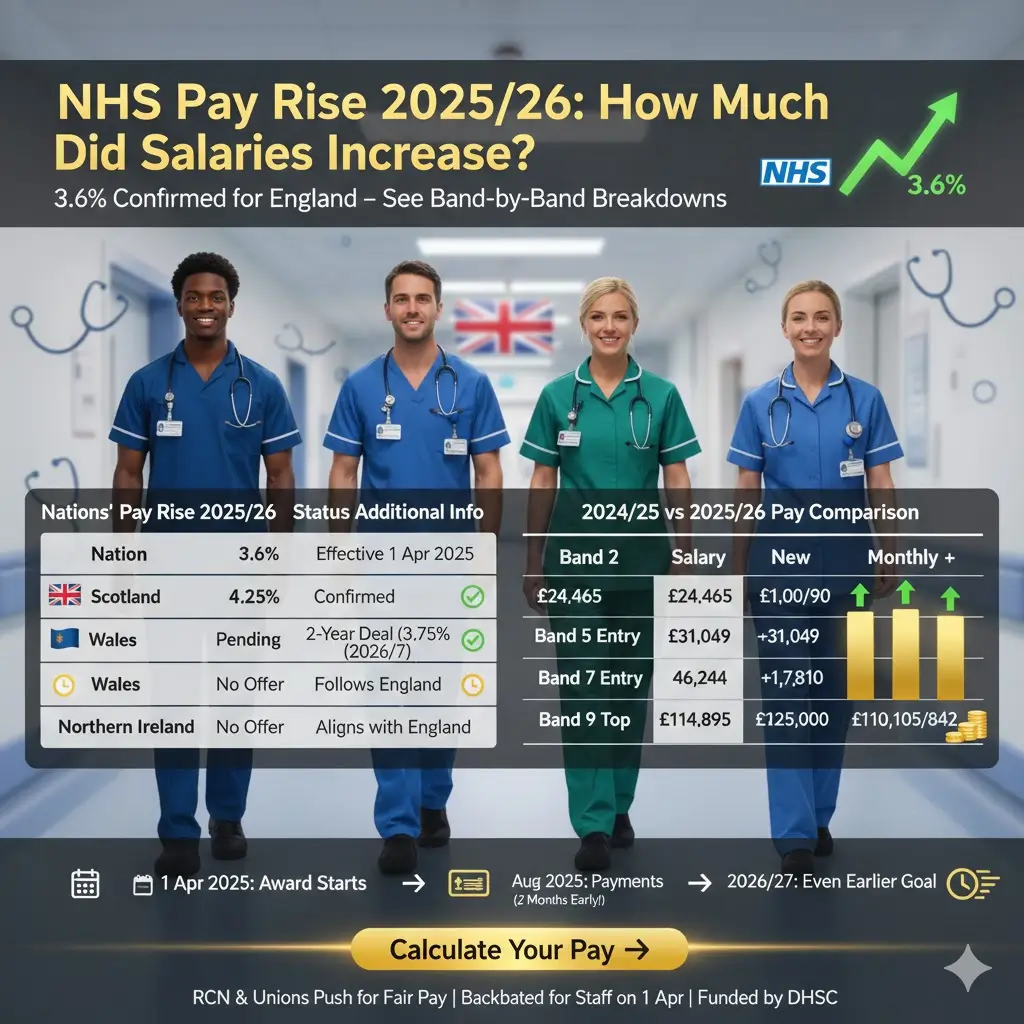
The NHS Pay Review Body submitted its 38th report, recommending a consolidated pay increase for all Agenda for Change staff. The government accepted a 3.6% pay award for 2025/26, effective from 1 April 2025.
The Royal College of Nursing and other trade unions, including the GMB, Unison and Unite, have continued to campaign for meaningful pay increases. The RCN has emphasised the need for fair, timely and consistent incremental steps within each band, alongside meaningful differences between pay bands.
Staff employed on 1 April 2025 received backdated payments reflecting the new rates from the start of the financial year. The pay award was funded through the Department of Health and Social Care budget following evidence submitted to the NHS Pay Review Body.
This table shows the exact salary increase for each band following the 3.6% pay award:
Band
2024/25 Salary
2025/26 Salary
Annual Increase
Monthly Increase
Band 2
£23,614
£24,465
+£851
+£71
Band 3 (entry)
£24,071
£24,937
+£866
+£72
Band 3 (top)
£25,674
£26,598
+£924
+£77
Band 4 (entry)
£26,530
£27,485
+£955
+£80
Band 4 (top)
£29,114
£30,162
+£1,048
+£87
Band 5 (entry)
£29,969
£31,049
+£1,080
+£90
Band 5 (mid)
£32,324
£33,487
+£1,163
+£97
Band 5 (top)
£36,483
£37,796
+£1,313
+£109
Band 6 (entry)
£37,339
£38,682
+£1,343
+£112
Band 6 (mid)
£39,404
£40,823
+£1,419
+£118
Band 6 (top)
£44,962
£46,580
+£1,618
+£135
Band 7 (entry)
£46,148
£47,810
+£1,662
+£139
Band 7 (mid)
£48,526
£50,273
+£1,747
+£146
Band 7 (top)
£52,809
£54,710
+£1,901
+£158
Band 8a (top)
£60,503
£62,682
+£2,179
+£182
Band 8b (top)
£72,294
£74,896
+£2,602
+£217
Band 8c (top)
£85,601
£88,682
+£3,081
+£257
Band 8d (top)
£101,677
£105,337
+£3,660
+£305
Band 9 (top)
£121,271
£125,637
+£4,366
+£364
Pay Award Implementation Timeline
The government implemented the 2025/26 pay award two months earlier than the previous year. Staff received their uplifts from August 2025, with payments backdated to 1 April 2025. This improved timeline followed criticism of delayed payments in previous years.
For the 2026/27 pay round, the Department of Health and Social Care has already submitted written evidence to the NHS Pay Review Body in July 2025, with an ambition to implement pay awards even earlier in the 2026/27 financial year.
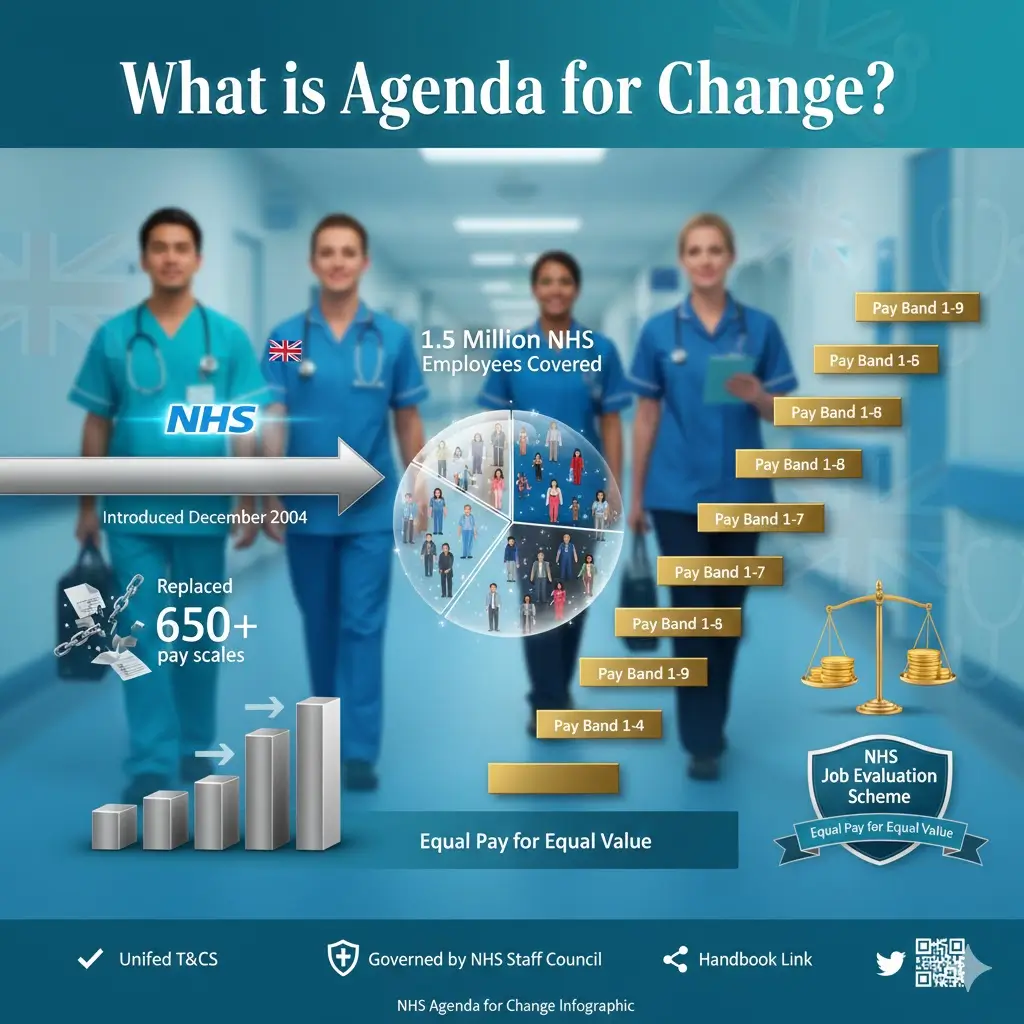
Agenda for Change (AfC) is the national pay system covering approximately 1.5 million NHS employees across the United Kingdom. Introduced in December 2004, this standardised framework replaced over 650 different pay scales, terms and conditions with a unified structure based on job evaluation.
Under the AfC framework, every NHS role is assessed using the NHS Job Evaluation Scheme and assigned to one of nine pay bands. This ensures equal pay for work of equal value across the health service, regardless of job title or location. The system is governed by the NHS Terms and Conditions of Service Handbook, maintained by the NHS Staff Council.
Who is Covered by Agenda for Change?
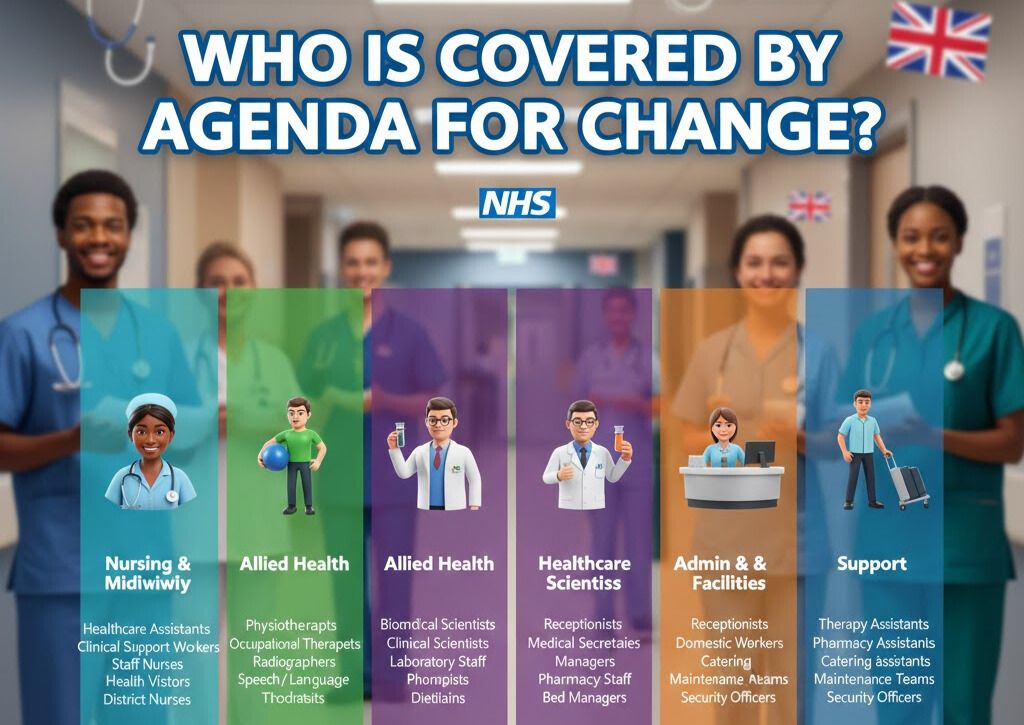
The AfC pay structure covers:
Nursing and midwifery staff — healthcare assistants, clinical support workers, staff nurses, midwives, health visitors, district nurses
Allied health professionals — physiotherapists, occupational therapists, radiographers, speech and language therapists, podiatrists, dietitians
Band 2 operates as a flat-rate salary band with no incremental pay progression. All Band 2 staff earn £24,465 regardless of years of service, making this the simplest pay structure within Agenda for Change.
Following the 3.6% pay award, Band 2 wages increased by £851 annually compared to 2024/25. The hourly rate of £12.51 now exceeds the National Living Wage of £12.21 for workers aged 21 and over, ensuring NHS support workers earn above the statutory minimum.
Trade unions, including the GM,B have campaigned for Band 2 wages to reach £15 per hour, arguing that healthcare support workers deserve significantly higher remuneration for their essential work.
The Royal College of Nursing is supporting hundreds of members to challenge their current pay band where they perform Band 3 nursing support worker duties but are paid on Band 2. This work is expected to increase significantly as the RCN pushes employers to implement the new nursing profiles developed under Agenda for Change.
Many NHS trusts have conducted reviews of Band 2 roles and found staff routinely performing clinical duties—such as blood pressure monitoring, glucose testing and wound care—that should be remunerated at Band 3 rates. If you believe your role has been incorrectly banded, you can raise this through your trust’s job matching process or contact your trade union representative.
Typical Band 2 roles include:
Healthcare assistants (HCAs) and clinical support workers
Band 3 offers one pay progression step after two years of satisfactory service, increasing annual earnings by £1,661. This represents a meaningful reward for experience and continued professional development.
Typical Band 3 roles include:
Senior healthcare assistants and clinical support workers
Band 4 staff progress to the top pay point after three years, gaining an additional £2,677 per year. This band represents an important bridge between support roles and registered professional positions.
Typical Band 4 roles include:
Nursing associates (registered with NMC)
Associate practitioners and assistant practitioners
Band 5 is the starting band for newly qualified registered professionals. Staff progress through three pay points over four years, with total progression worth £6,747 from entry to the top of the band.
The starting salary for a Band 5 nurse has increased significantly over the past decade—from £21,692 in 2015 to £31,049 in 2025/26, representing a 43% nominal increase. This makes NHS nursing salaries increasingly competitive with the private healthcare sector and reflects sustained investment in the nursing workforce.
Typical Band 5 roles include:
Staff nurses and registered nurses
Newly qualified midwives
Paramedics
Physiotherapists and occupational therapists
Operating department practitioners (ODPs)
Speech and language therapists
Podiatrists and chiropodists
Therapeutic and diagnostic radiographers
Practice managers and ICT test analysts
Band 5 to Band 6 Progression
Research by the Institute for Fiscal Studies examined how quickly new starters in Band 5 progress to Band 6 and beyond. Band 5 represents the entry point for newly qualified nurses joining the NHS, with progression to Band 6 requiring demonstration of specialist skills and leadership capabilities.
The Royal College of Nursing is actively campaigning for improved progression pathways from Band 5 to Band 6, arguing that nurses should have the same structured progression enjoyed by midwifery and paramedic colleagues. This campaign aims to create clearer career advancement routes for nursing staff.
Band 6 represents experienced practitioners and clinical team leaders. Progression to the top of the band takes five years, providing a total increase of £7,898 from the entry point.
Typical Band 6 roles include:
Junior sisters and charge nurses
Experienced midwives and community midwives
Senior paramedics and emergency care practitioners
Band 7 covers senior clinical and management positions with significant responsibility for service delivery, staff supervision and budget management. Staff reaching the top of the band after five years earn £6,900 more than at entry.
Typical Band 7 roles include:
Ward sisters and ward managers
Team leaders and clinical leads
Advanced nurse practitioners
Senior pharmacists
Senior physiotherapists and occupational therapists
Band 8a marks the beginning of senior management and consultant-level clinical roles within the NHS. The NHS Pay Review Body recommended adding intermediate pay points to Band 8a in their 2024 report to improve pay progression at this level.
Typical Band 8a roles include:
Modern matrons
Advanced clinical practitioners (ACPs)
Service managers
Speciality leads
Principal pharmacists
Consultant allied health professionals
Important: There is no automatic advancement from Band 8a to 8b. Progression requires applying for and securing a higher-banded position through the normal recruitment process.
Band 8b NHS Pay 2025/26
Years of Service
Annual Salary
Monthly Gross
Hourly Rate
0-2 years
£64,455
£5,371
£32.96
2-5 years
£68,631
£5,719
£35.10
5+ years
£74,896
£6,241
£38.30
Band 8b encompasses senior clinical and managerial leaders responsible for significant departmental or service-wide functions.
Typical Band 8b roles include:
Lead pharmacists
Lead clinicians
Clinical psychologists (experienced)
Consultant nurses
Heads of therapy services
Note: There is no automatic advancement from Band 8b to 8c.
Band 8c NHS Pay 2025/26
Years of Service
Annual Salary
Monthly Gross
Hourly Rate
0-2 years
£76,965
£6,414
£39.36
2-5 years
£81,652
£6,804
£41.76
5+ years
£88,682
£7,390
£45.35
Typical Band 8c roles include:
Heads of clinical service
Associate directors of nursing
Senior HR managers
Tactical response leads
Service owners
Clinical directors (some organisations)
Note: There is no automatic advancement from Band 8c to 8d.
Band 8d NHS Pay 2025/26
Years of Service
Annual Salary
Monthly Gross
Hourly Rate
0-2 years
£91,342
£7,612
£46.71
2-5 years
£96,941
£8,078
£49.58
5+ years
£105,337
£8,778
£53.87
Typical Band 8d roles include:
Deputy directors of clinical services
Deputy chief nurses
Consultant clinical scientists
Departmental heads
Associate directors
Band 9 NHS Pay 2025/26
Years of Service
Annual Salary
Monthly Gross
Hourly Rate
0-2 years
£109,179
£9,098
£55.84
2-5 years
£115,763
£9,647
£59.20
5+ years
£125,637
£10,470
£64.25
Band 9 is the highest Agenda for Change pay band, reserved for the most senior NHS clinical leaders. These roles carry trust-wide or regional responsibility for clinical standards, workforce development and strategic direction.
Typical Band 9 roles include:
Nurse consultants
Directors of clinical services
Chief nursing officers
Directors of allied health professions
Very senior NHS managers
NHS Pay Bands by Region: England, Scotland, Wales & Northern Ireland
Salaries differ across the four UK nations due to devolved health services and separate pay negotiations conducted by each government. Understanding these differences is important for NHS workers considering relocation or cross-border employment.
Complete Regional Comparison Table
Band
England
Scotland
Wales
Northern Ireland
Band 2 (entry)
£24,465
£25,694
£23,970
£22,383
Band 2 (top)
£24,465
£27,900
£23,970
£22,383
Band 3 (entry)
£24,937
£28,011
£24,433
£22,816
Band 3 (top)
£26,598
£30,230
£26,060
£24,336
Band 4 (entry)
£27,485
£30,353
£26,928
£25,147
Band 4 (top)
£30,162
£33,016
£29,551
£27,596
Band 5 (entry)
£31,049
£33,247
£30,420
£28,407
Band 5 (mid)
£33,487
£35,525
£32,809
£30,639
Band 5 (top)
£37,796
£41,424
£37,029
£34,581
Band 6 (entry)
£38,682
£41,608
£37,898
£35,392
Band 6 (mid)
£40,823
£43,441
£39,996
£37,350
Band 6 (top)
£46,580
£50,702
£45,636
£42,618
Band 7 (entry)
£47,810
£50,861
£46,840
£43,742
Band 7 (mid)
£50,273
£52,804
£49,254
£45,996
Band 7 (top)
£54,710
£59,159
£53,601
£50,056
Band 8a (top)
£62,682
£67,665
£61,412
£57,349
Band 8b (top)
£74,896
£79,164
£73,378
£68,525
Band 8c (top)
£88,682
£93,685
£86,885
£81,138
Band 8d (top)
£105,337
£108,206
£103,202
£96,376
Band 9 (top)
£125,637
£128,051
£123,090
£114,949
Key Regional Differences
NHS Scotland pays the highest salaries across all Agenda for Change bands. Scottish NHS staff received a 4.25% pay rise for 2025/26—significantly higher than England’s 3.6%. Scotland also secured a two-year pay deal guaranteeing 3.75% in 2026/27, providing greater certainty for workforce planning.
A Band 5 nurse at the top of the band earns £41,424 in Scotland compared to £37,796 in England—a difference of £3,628 annually. This premium makes Scotland increasingly attractive for NHS recruitment and retention.
Northern Ireland has the lowest pay rates across all bands. A top-of-band Band 5 nurse in Northern Ireland earns £34,581—some £3,215 less than their counterpart in England and £6,843 less than in Scotland. Trade unions have highlighted this disparity as a significant barrier to recruitment.
Wales typically follows England’s pay structure closely. At the time of publication, no formal 2025/26 pay offer had been announced for Wales, though rates are expected to align with the 3.6% increase applied in England.
Northern Ireland Pay Dispute
The Royal College of Nursing remains in formal dispute with the Northern Ireland Executive following the absence of a pay award for Health and Social Care nursing staff. This ongoing dispute highlights the significant pay gap between Northern Ireland and the rest of the UK, with Band 5 nurses at the top of the band earning £3,215 less than colleagues in England and £6,843 less than those in Scotland.
London and High-Cost Area Supplements
NHS staff working in London and the surrounding areas receive additional payments to reflect significantly higher living costs. These High Cost Area Supplements (HCAS), also known as London weighting, are added to the basic salary.
Zone
Supplement Rate
Minimum Payment
Maximum Payment
Inner London
20% of basic salary
£5,414
£8,172
Outer London
15% of basic salary
£4,551
£5,735
Fringe
5% of basic salary
£1,258
£2,122
London Pay Examples (Band 5 Entry Point)
Location
Basic Salary
HCAS
Total Annual Salary
Total Hourly Rate
Rest of England
£31,049
£0
£31,049
£15.88
Fringe areas
£31,049
£1,552
£32,601
£16.67
Outer London
£31,049
£4,657
£35,706
£18.26
Inner London
£31,049
£6,210
£37,259
£19.05
The high-cost area supplement makes a substantial difference—an Inner London Band 5 nurse earns £6,210 more annually than a colleague in the same role outside London. At the top of the band, Inner London staff on Band 5 can earn up to £45,356, including the maximum HCAS.
Inner London Pay Scales with HCAS (Selected Bands)
Band
Pay Step
Annual Value
Hourly Value
Band 2
Entry/Top
£30,074
£15.38
Band 5
Entry
£38,784
£19.83
Band 5
Top
£45,356
£23.20
Band 6
Entry
£46,419
£23.74
Band 6
Top
£55,046
£28.15
Band 7
Top
£62,882
£32.16
Which Areas Qualify?
Inner London: Trusts within zones 1-4 of the London Underground network
Outer London: Remaining Greater London boroughs
Fringe: Surrounding areas including parts of Essex, Hertfordshire, Kent and Surrey
NHS Pay Progression: How to Move Up the Pay Scale
Understanding incremental pay progression helps you plan your career development and forecast future earnings. The 2018 NHS pay deal reformed progression from spine points to years of service at each band, ensuring staff with greater responsibility are not paid less than those in lower bands.
Pay Progression Timeline by Band
Band
Entry to Intermediate
Intermediate to Top
Total Years to Top
Band 2
—
—
Flat rate (no progression)
Band 3
2 years
—
2 years
Band 4
3 years
—
3 years
Band 5
2 years
2 years
4 years
Band 6
2 years
3 years
5 years
Band 7
2 years
3 years
5 years
Band 8a
2 years
3 years
5 years
Band 8b
2 years
3 years
5 years
Band 8c
2 years
3 years
5 years
Band 8d
2 years
3 years
5 years
Band 9
2 years
3 years
5 years
Requirements for Pay Progression
To progress to the next pay point, you must demonstrate:
Satisfactory performance at annual appraisal using the Knowledge and Skills Framework (KSF)
Completion of required training, including statutory and mandatory updates
No ongoing disciplinary procedures affecting your employment
Achievement of objectives set in your personal development plan
Your line manager must confirm these requirements are met before your pay step date—the anniversary of when you started in your current band or reached your current pay point. This date is also known as your incremental date.
Key Progression Rules
New NHS starters begin at the entry point of their assigned pay band
Promotion to a higher band places you on the lowest pay point that provides a salary increase over your current earnings—your incremental date resets
Moving to a lower band typically matches you to the closest pay point without reducing your salary
Acting up arrangements (temporary promotion) pay at the higher band rate, usually for periods of 1-6 months
Staff moving within the same band keep their current pay step and incremental date
Breaks in service under one month usually allow re-entry at the previous pay step
Breaks over 12 months may reset your pay to the entry point
NHS Hourly Pay Rates 2025/26: Complete Breakdown
Hourly rates are essential for calculating overtime payments, bank shift earnings and comparing NHS wages with agency rates. The standard NHS working year is 1,957.5 hours based on a full-time equivalent (FTE) of 37.5 contracted hours per week.
Band
Entry Hourly
Intermediate Hourly
Top Hourly
Band 2
£12.51
—
£12.51
Band 3
£12.75
—
£13.60
Band 4
£14.06
—
£15.43
Band 5
£15.88
£17.13
£19.33
Band 6
£19.78
£20.88
£23.82
Band 7
£24.45
£25.71
£27.98
Band 8a
£28.48
£29.91
£32.06
Band 8b
£32.96
£35.10
£38.30
Band 8c
£39.36
£41.76
£45.35
Band 8d
£46.71
£49.58
£53.87
Band 9
£55.84
£59.20
£64.25
Comparison with the National Living Wage
Rate Type
Hourly Rate
National Living Wage (21+)
£12.21
NHS Band 2
£12.51
NHS Band 3 (entry)
£12.75
NHS Band 2 and Band 3 hourly rates now exceed the National Living Wage, though some staff have received temporary uplifts to ensure compliance with minimum wage requirements.
Unsocial Hours Enhancements
NHS staff working outside standard hours receive enhanced payments calculated as a percentage of their basic hourly rate:
Time Period
Enhancement Rate
Example (Band 5 Entry)
Saturday (all hours)
Time plus 30%
£20.64/hour
Sunday (all hours)
Time plus 60%
£25.41/hour
Night shifts (8 pm-6 am weekdays)
Time plus 30%
£20.64/hour
Bank holidays
Time plus 60%
£25.41/hour
NHS Pension Contributions by Salary
Your NHS pension contribution is deducted automatically from your gross salary based on your earnings tier. The NHS Pension Scheme operates on a tiered contribution system where higher earners pay a larger percentage.
Annual Pensionable Pay
Contribution Rate
Up to £13,246
5.2%
£13,247 to £21,015
6.5%
£21,016 to £28,831
7.7%
£28,832 to £54,763
9.8%
£54,764 to £70,630
10.7%
£70,631 to £111,377
11.6%
£111,378 and above
12.5%
Pension Contribution Examples by Band
Band
Annual Salary
Contribution Rate
Annual Deduction
Monthly Deduction
Band 2
£24,465
7.7%
£1,884
£157
Band 3 (top)
£26,598
7.7%
£2,048
£171
Band 5 (entry)
£31,049
9.8%
£3,043
£254
Band 5 (top)
£37,796
9.8%
£3,704
£309
Band 6 (top)
£46,580
9.8%
£4,565
£380
Band 7 (top)
£54,710
9.8%
£5,362
£447
Band 8a (top)
£62,682
10.7%
£6,707
£559
Band 9 (top)
£125,637
12.5%
£15,705
£1,309
The NHS Pension Scheme provides a defined benefit pension based on your career average earnings, making it one of the most valuable employee benefits in the public sector. Employer contributions are significantly higher than employee rates.
Band 1 is closed to new entrants as part of the 2018 Agenda for Change pay deal reforms. This lowest pay band was phased out to improve entry-level NHS wages and simplify the pay structure.
Any staff remaining on Band 1 contracts are now paid at Band 2 rates (£24,465). No new Band 1 positions have been created since 2018, and trusts have regraded existing Band 1 roles to Band 2 or higher.
This change was part of broader NHS pay reforms that also introduced:
Removal of overlapping pay points between bands
Transition from spine points to year-based progression
Faster progression to tthe op of the band for lower bands
Meaningful differences between pay bands
Calculate Your NHS Take-Home Pay
Your gross salary differs significantly from what you actually receive each month. Understanding the gap between annual salary and take-home pay helps with financial planning and budgeting.
Main Deductions from NHS Salary
Deduction
Rate/Amount
Notes
NHS Pension
5.2% to 12.5%
Based on salary tier
Income Tax
20%/40%/45%
Based on earnings above personal allowance (£12,570)
National Insurance
12% then 2%
12% on £12,570-£50,270, then 2% above
Student Loan
9%
Above threshold (varies by plan type)
Band 5 Take-Home Pay Example (Entry Point)
Element
Annual
Monthly
Gross salary
£31,049
£2,587
NHS Pension (9.8%)
-£3,043
-£254
Income tax
-£3,696
-£308
National Insurance
-£2,217
-£185
Estimated take-home
£22,093
£1,841
Band 6 Take-Home Pay Example (Top of Band)
Element
Annual
Monthly
Gross salary
£46,580
£3,882
NHS Pension (9.8%)
-£4,565
-£380
Income tax
-£6,802
-£567
National Insurance
-£4,081
-£340
Estimated take-home
£31,132
£2,594
Band 7 Take-Home Pay Example (Top of Band)
Element
Annual
Monthly
Gross salary
£54,710
£4,559
NHS Pension (9.8%)
-£5,362
-£447
Income tax
-£8,428
-£702
National Insurance
-£4,619
-£385
Estimated take-home
£36,301
£3,025
Your actual take-home pay depends on your specific circumstances, including tax code, pension tier, student loan plan, salary sacrifice schemes and any additional allowances.
Understanding Your NHS Payslip
Your NHS payslip contains several key elements that determine your actual earnings:
Income Section
Basic pay — Your standard monthly salary based on your band and pay point
Enhancements — Unsocial hours, overtime, bank holiday payments
Allowances — London weighting, on-call supplements, recruitment premiums
Deductions Section
Superannuation — Your NHS pension contribution
Income tax — PAYE deductions based on your tax code
National Insurance — Employee NI contributions
Student loan — If applicable, deducted above threshold
Salary sacrifice — Cycle to work, childcare vouchers, lease cars
Key Tax Codes to Understand
1257L — Standard personal allowance (£12,570 tax-free)
BR — Basic rate tax on all earnings (usually second job)
0T — No personal allowance (emergency code)
K codes — You owe tax from previous years
NHS Pay History: How Salaries Have Changed
Understanding pay trends helps contextualise current salaries and future expectations. The NHS Pay Review Body publishes annual recommendations based on evidence from government, NHS Employers, trade unions and other stakeholders.
Band 5 Starting Salary History
Year
Starting Salary
Annual Change
2015/16
£21,692
—
2016/17
£21,909
+1.0%
2017/18
£22,128
+1.0%
2018/19
£23,023
+4.0% (3-year deal)
2019/20
£24,214
+5.2%
2020/21
£24,907
+2.9%
2021/22
£25,655
+3.0%
2022/23
£27,055
+5.5%
2023/24
£28,407
+5.0%
2024/25
£29,969
+5.5%
2025/26
£31,049
+3.6%
Over the past decade, the Band 5 starting salary has increased by £9,357 in nominal terms, representing a 43% increase since 2015. However, when adjusted for inflation, real-terms pay growth has been more modest, and the Royal College of Nursing continues to campaign for further improvements.
When is the Next NHS Pay Rise?
The next NHS pay rise will be effective from 1 April 2026 for the 2026/27 financial year. Key dates:
Spring 2026: NHS Pay Review Body receives evidence from government, NHS Employers and trade unions
May-June 2026: NHS Pay Review Body publishes recommendations
Summer 2026: Government announces whether it accepts recommendations
1 April 2026: New pay rates effective (may be backdated)
Scotland has already confirmed a 3.75% increase for 2026/27 as part of their two-year deal.
2026/27 NHS Pay Round: What to Expect
The government has already begun preparations for the 2026/27 pay round. Key developments include:
July 2025: Department of Health and Social Care submitted written evidence to the NHS Pay Review Body
Autumn 2025: NHS Employers, Royal College of Nursing, Unison, GMB and other trade unions submit evidence
Spring 2026: NHS Pay Review Body publishes recommendations
April 2026: New pay rates effective from 1 April 2026
The government evidence submission for 2026/27 outlines workforce priorities aligned with the 10 Year Health Plan, including reforms to Agenda for Change career structures and enhanced progression pathways at Bands 6 and 7 for experienced professionals.
Scotland has already confirmed a 3.75% pay increase for 2026/27 as part of their two-year deal, providing certainty for Scottish NHS staff ahead of the wider UK negotiations.
Frequently Asked Questions
What is a Band 5 NHS salary in 2025/26?
Band 5 NHS salary ranges from £31,049 at the entry point to £37,796 at the top of the band in England for 2025/26. The hourly rate is £15.88 to £19.33. Band 5 is the starting point for newly qualified nurses, midwives, paramedics and allied health professionals such as physiotherapists, occupational therapists and radiographers.
What is the NHS Band 2 hourly rate 2025/26?
NHS Band 2 hourly rate is £12.51 in England for 2025/26. This is calculated from the annual salary of £24,465 divided by 1,957.5 working hours per year. Band 2 is a flat-rate band with no pay progression regardless of length of service. The rate exceeds the National Living Wage of £12.21.
How much did NHS pay rise in 2025/26?
NHS staff in England received a 3.6% pay rise for 2025/26, effective from 1 April 2025. Scotland received a higher increase of 4.25% as part of a two-year deal that also guarantees 3.75% for 2026/27. Wales and Northern Ireland had not announced formal pay offers at the start of the financial year, but typically follow England’s settlement.
Does NHS Scotland pay more than NHS England?
Yes, NHS Scotland pays more than NHS England across all Agenda for Change bands. Scotland’s 4.25% pay rise for 2025/26 exceeds England’s 3.6%, and Scottish base salaries are higher at every band level. A Band 5 nurse at the top of the band earns £41,424 in Scotland compared to £37,796 in England—a difference of £3,628 annually.
How long does it take to reach the top of the NHS band?
Most NHS pay bands take 4-5 years to reach the top of the band through incremental progression. Band 2 has no progression (flat rate). Bands 3-4 take 2-3 years. Bands 5-9 typically take 4-5 years, progressing through entry, intermediate and top pay points subject to satisfactory performance at annual appraisal.
What is the highest NHS pay band?
Band 9 is the highest Agenda for Change pay band, with salaries ranging from £109,179 to £125,637 in England for 2025/26. Band 9 roles include nurse consultants, directors of clinical services, chief nursing officers and very senior NHS managers.
Is there automatic progression between Band 8 sub-bands?
No, there is no automatic advancement between Band 8a, 8b, 8c and 8d. Moving between these sub-bands requires applying for and securing a higher-banded position through the normal recruitment process. Within each Band 8 sub-band, you progress through pay points over 5 years.
When is the next NHS pay rise?
The next NHS pay rise will be effective from 1 April 2026 for the 2026/27 financial year. Scotland has already confirmed a 3.75% increase for 2026/27 as part of their two-year deal. England, Wales and Northern Ireland will receive recommendations from the NHS Pay Review Body in spring 2026.
Do NHS bank staff get the same hourly rate?
NHS bank staff are typically paid at the same basic hourly rate as permanent staff for their band. However, bank workers do not receive paid annual leave or automatic pension enrolment, so the headline hourly rate may appear higher to compensate. Bank shifts may also attract enhanced rates for unsocial hours.
What is the NHS personal allowance for tax?
NHS staff receive the same personal allowance as all UK taxpayers—£12,570 for 2025/26. You do not pay income tax on earnings up to this threshold. The standard tax code reflecting this allowance is 1257L. Income above the personal allowance is taxed at 20% up to £50,270.
Data Sources and Official References
The salary information in this guide is based on official pay scales published by NHS Employers for England. Pay rates shown are effective from 1 April 2025 unless otherwise stated.
Key sources:
NHS Employers — Official pay scales and High Cost Area Supplements
NHS Pay Review Body — Independent body recommending annual pay awards
NHS Staff Council — Maintains the NHS Terms and Conditions of Service Handbook
Department of Health and Social Care — Funding and policy decisions
Scottish Government — NHS Scotland pay scales and negotiations
Royal College of Nursing — Trade union representing nursing staff
Agenda for Change terms and conditions are set out in the NHS Terms and Conditions of Service Handbook, which provides definitive guidance on pay progression, annual leave, sick pay and other employment matters.