How NHS Overtime Pay Works Under Agenda for Change
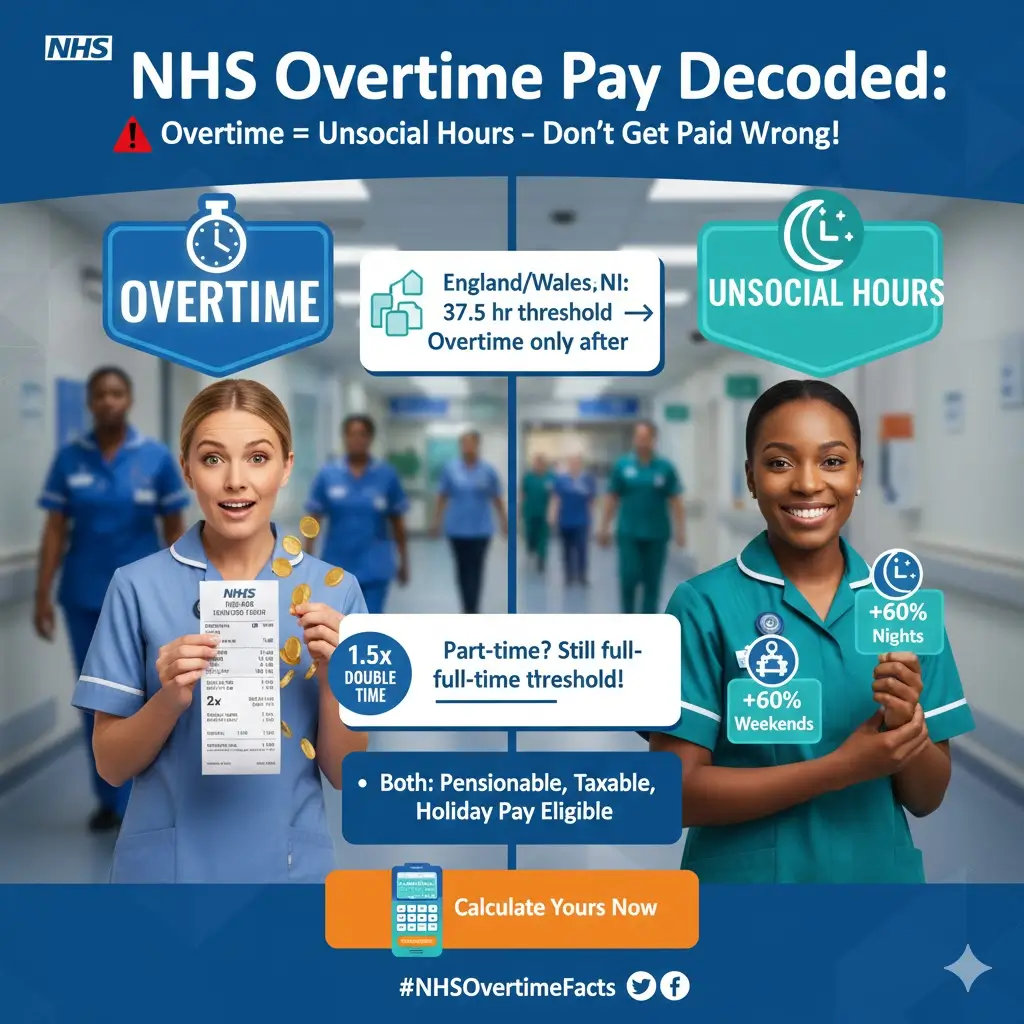
Understanding NHS overtime pay starts with one critical distinction most healthcare assistants, registered nurses, midwives and allied health professionals get wrong: overtime and unsocial hours are completely different payment types.
Under the NHS Terms and Conditions of Service Handbook (commonly called Agenda for Change or AfC), these payments follow separate rules:
Overtime applies only when you work beyond standard weekly hours:
- England, Wales, Northern Ireland: 37.5 hours per week
- Scotland: 37 hours per week
Whether you’re a part-time Band 5 staff nurse working 22.5 hours or a Band 3 clinical support worker on 30 hours, overtime rates only begin after exceeding the full-time equivalent threshold — not your contracted hours.
Read Guide: NHS Band 5 Pay 2025/26
Unsocial hours enhancements apply to shifts worked at antisocial times within your contracted hours. These are percentage additions to your basic hourly rate, calculated separately from overtime multipliers.
Both payment types share important characteristics:
- Pensionable — count towards NHS Pension contributions and future benefits
- Taxable — subject to income tax and National Insurance deductions
- Included in holiday pay — if worked regularly over the reference period
This distinction matters because many Band 5 newly qualified nurses, Band 2 healthcare assistants, porters, cleaners and Band 7 ward managers unknowingly accept extra shifts expecting enhanced rates, only to receive standard pay. After all, they haven’t exceeded the full-time threshold.
Read Guide: NHS Pay Bands 2025/26
NHS Overtime Rates Explained
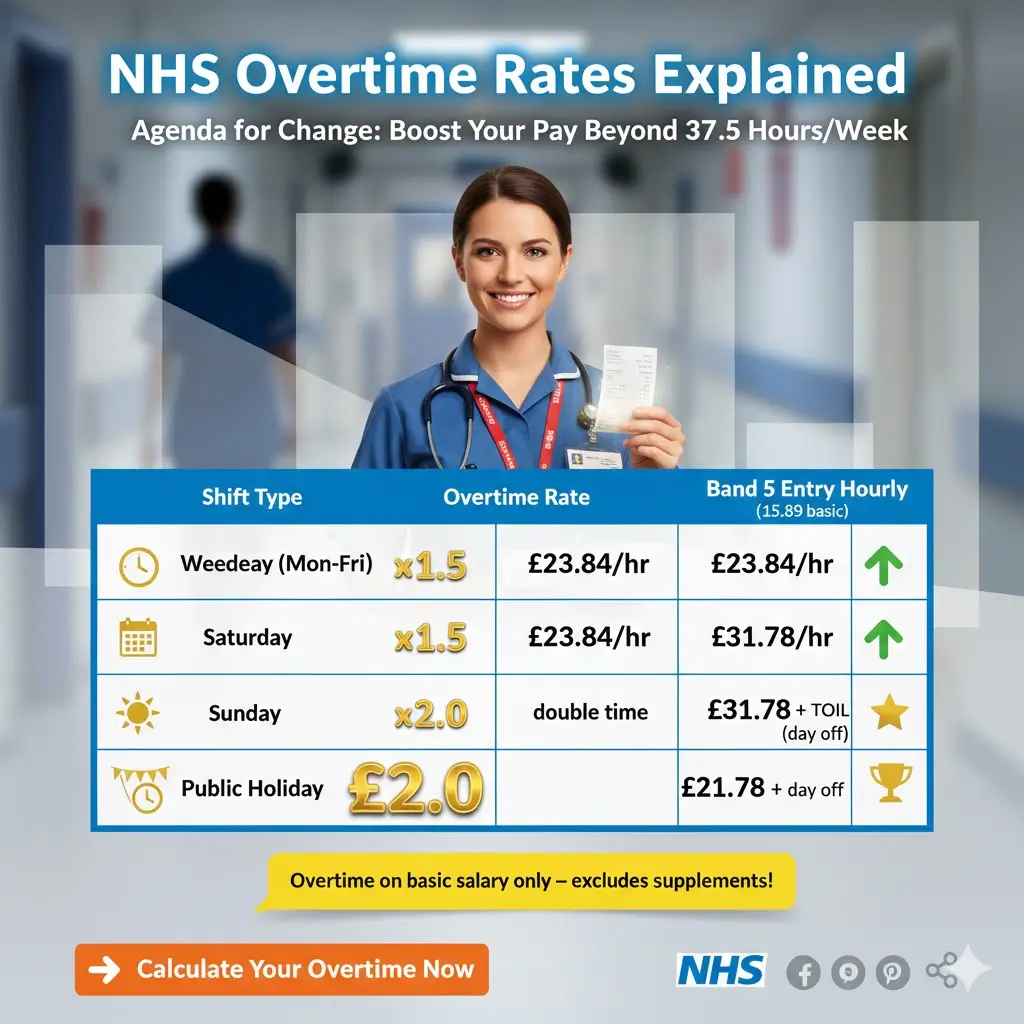
When you genuinely work overtime (hours beyond 37.5 per week in England, Wales and Northern Ireland, or 37 hours in Scotland), Agenda for Change provides enhanced payment rates.
Read Guide: NHS Band 6 Pay 2025/26
Weekday Overtime (Monday to Friday)
Working extra hours on weekdays beyond standard hours attracts time and a half (×1.5).
For a Band 5 registered nurse at entry point (£31,049 annual, £15.89/hr basic):
- Weekday overtime pays £23.84 per hour
Saturday Overtime
All Saturday hours worked as overtime attract time and a half (×1.5) — identical to weekday overtime.
For Band 5 entry: £23.84 per hour
Sunday Overtime
Sunday overtime commands the highest regular premium at double time (×2.0).
For Band 5 entry: £31.78 per hour — exactly double the basic rate.
Read Guide: NHS Band 7 Pay 2025/26
General Public Holiday Overtime
Public holidays attract double time (×2.0) plus time off in lieu (TOIL).
You receive twice your hourly rate for hours worked, plus an equivalent day off to take later. Bank holiday overtime represents the most valuable shift type in total compensation terms.
| Shift Type | Overtime Rate | Band 5 Entry Hourly |
| Weekday (Mon–Fri) | ×1.5 | £23.84 |
| Saturday | ×1.5 | £23.84 |
| Sunday | ×2.0 | £31.78 |
| Public Holiday | ×2.0 + TOIL | £31.78 + day off |
Important: Overtime payments are calculated on basic salary only. High Cost Area Supplements, recruitment and retention premia, and other allowances are excluded from overtime calculations.
Read Guide: NHS Band 3 Pay 2025/26
Unsocial Hours Enhancements by Band
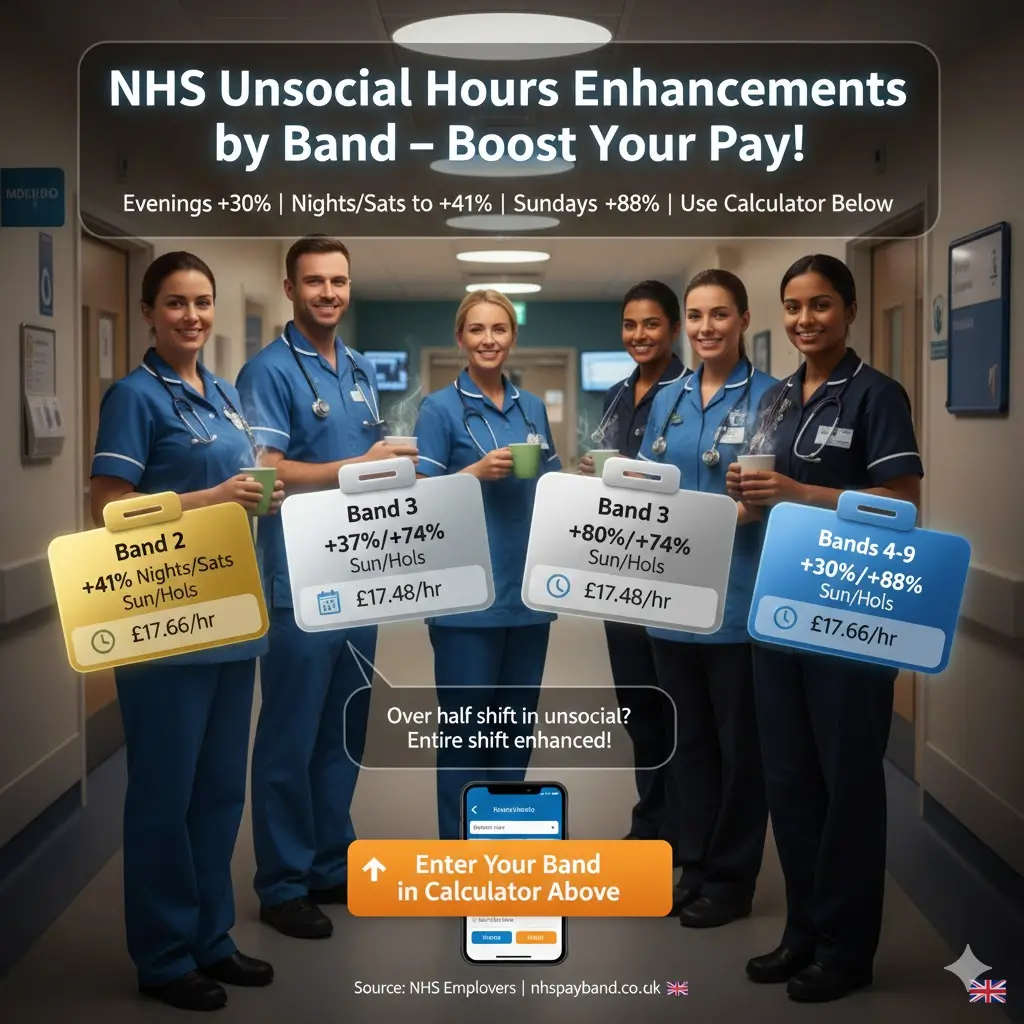
Unsocial hours payments reward porters, healthcare assistants, nurses, midwives, paramedics, physiotherapists, occupational therapists, speech therapists and other AfC staff who work antisocial shifts within their contracted hours. Enhancement percentages vary by pay band — lower bands receive higher uplifts to compensate for lower basic salaries.
What Counts as Unsocial Hours?
Under Agenda for Change, unsocial hours include:
- Weekday evenings: Typically 8 pm to midnight on Monday–Thursday
- Weekday nights: 8 pm to 6 am Monday–Friday
- Saturdays: Midnight Friday to midnight Saturday (full 24 hours)
- Sundays: Midnight Saturday to midnight Sunday (full 24 hours)
- Public holidays: The full 24-hour period
Half-shift rule: When more than half of a weekday shift (not a public holiday) falls within unsocial hours, the entire shift qualifies for enhancement.
Read Guide: NHS Band 2 Pay 2025/26
Evening Enhancements (+30%)
Evening shifts (8 pm to midnight on weekdays) are paid at +30% enhancement on your basic hourly rate across all bands. The calculator treats weekday evenings as unsocial hours and adds this uplift automatically.
Band 2 Unsocial Hours Rates
Healthcare assistants, porters, domestic staff, cleaners, catering assistants and other Band 2 employees receive the highest enhancement percentages:
- Weekday evenings/nights and Saturdays: +41%
- Sundays and public holidays: +88%
For Band 2 (£24,465 annual, £12.52/hr basic):
- Night/Saturday enhanced rate: £17.66/hr
- Sunday/public holiday enhanced rate: £23.54/hr
Band 3 Unsocial Hours Rates
Senior healthcare assistants, dental nurses, clinical support workers, pharmacy assistants and administrative workers receive:
- Weekday evenings/nights and Saturdays: +37%
- Sundays and public holidays: +74%
For Band 3 entry (£24,937 annual, £12.76/hr basic):
- Night/Saturday enhanced rate: £17.48/hr
- Sunday/public holiday enhanced rate: £22.21/hr
Bands 4–9 Unsocial Hours Rates
All staff from Band 4 assistant practitioners and nursing associates through Band 9 executives receive standardised enhancement rates:
- Weekday evenings/nights and Saturdays: +30%
- Sundays and public holidays: +68%
| Band | Night/Saturday Enhancement | Sunday/Public Holiday Enhancement |
| Band 2 | +41% | +88% |
| Band 3 | +37% | +74% |
| Bands 4–9 | +30% | +68% |
Source: NHS Employers, nhspayband.co.uk
→ Enter your band in the calculator above to see your exact enhanced rates
Stacked Enhancements: How Night and Weekend Pay Combines
One of the most valuable — and frequently misunderstood — aspects of NHS pay is stacked enhancements. When your shift spans multiple unsocial categories simultaneously, percentage uplifts combine.
How Stacking Works
- Saturday Night (8 pm Sat – 6 am Sun): Night + Saturday enhancements combine
- Sunday Night (8 pm Sun – 6 am Mon): Night + Sunday enhancements combine (nearly triple pay!)
- Bank Holiday Night: Night + Bank Holiday enhancements + TOIL entitlement
- Friday Night: Night enhancement only; hours after midnight may get Saturday rate locally
Saturday Night Stacking
Working a Saturday night shift (between 8 pm Saturday and 6 am Sunday) attracts both night enhancement and Saturday enhancement:
Bands 4–9 calculation:
- Night/evening enhancement: +30%
- Saturday enhancement: +30%
- Combined uplift: +60% (160% of basic)
For Band 5 entry (£15.89/hr basic), Saturday night pays £25.42 per hour.
Sunday Night Stacking
Sunday nights represent the highest-paying regular unsocial shifts:
Bands 4–9 calculation:
- Night/evening enhancement: +30%
- Sunday enhancement: +68%
- Combined uplift: +98% (198% of basic)
For Band 5 entry, Sunday night pays £31.46 per hour — nearly double the basic rate.
Band 2 Sunday nights reach +129% total enhancement (41% night + 88% Sunday), meaning those hours pay more than double the basic rate at £28.67 per hour.
Public Holiday Night Stacking
Public holiday nights attract maximum possible enhancement:
Bands 4–9 calculation:
- Night/evening enhancement: +30%
- Public holiday enhancement: +68%
- Combined uplift: +98% plus TOIL entitlement
| Shift Pattern | Enhancement (Bands 4–9) | Band 5 Entry Hourly |
| Weekday evening (after 8 pm) | +30% | £20.66 |
| Weekday night | +30% | £20.66 |
| Saturday day | +30% | £20.66 |
| Saturday night | +60% (stacked) | £25.42 |
| Sunday day | +68% | £26.69 |
| Sunday night | +98% (stacked) | £31.46 |
| Public holiday night | +98% + TOIL | £31.46 + TOIL |
Note: Always check your local Agenda for Change agreement — some Trusts cap maximum enhancements or interpret stacking differently.
Complete Band Comparison: Hourly Rates at a Glance
This table shows basic hourly rates and enhanced rates across all Agenda for Change bands using official 2025/26 figures with 3.6% uplift:
| Band | Entry Salary | Top Salary | Entry Hourly | Sat (+30%) | Sun (+68-88%) | Night (+30-41%) | Typical Roles |
| Band 2 | £24,465 | £24,465 | £12.52 | £16.28 | £23.54 (+88%) | £17.66 (+41%) | HCA, Porter, Cleaner |
| Band 3 | £24,937 | £26,598 | £12.76 | £16.59 | £22.21 (+74%) | £17.48 (+37%) | Senior HCA, Dental Nurse |
| Band 4 | £27,485 | £30,162 | £14.06 | £18.28 | £23.62 (+68%) | £18.28 (+30%) | Assistant Practitioner, Nursing Associate |
| Band 5 | £31,049 | £37,796 | £15.89 | £20.66 | £26.69 (+68%) | £20.66 (+30%) | RN, Midwife, Paramedic, Physio, OT |
| Band 6 | £38,682 | £46,580 | £19.79 | £25.73 | £33.25 (+68%) | £25.73 (+30%) | Senior Nurse, Specialist, Pharmacist |
| Band 7 | £47,810 | £54,710 | £24.47 | £31.81 | £41.11 (+68%) | £31.81 (+30%) | Ward Manager, ANP, Senior Midwife |
| Band 8a | £55,690 | £62,682 | £28.50 | £37.05 | £47.88 (+68%) | £37.05 (+30%) | Modern Matron, ACP |
| Band 8b | £64,455 | £74,896 | £32.99 | £42.89 | £55.42 (+68%) | £42.89 (+30%) | Senior Manager, Lead Pharmacist |
| Band 8c | £76,965 | £88,682 | £39.39 | £51.21 | £66.18 (+68%) | £51.21 (+30%) | Director, Head of Service |
| Band 8d | £91,342 | £105,337 | £46.74 | £60.76 | £78.52 (+68%) | £60.76 (+30%) | Senior Director, Deputy Chief Nurse |
| Band 9 | £109,179 | £125,637 | £55.86 | £72.62 | £93.84 (+68%) | £72.62 (+30%) | Executive, Chief Nursing Officer |
Key Insights:
- Band 2 has the highest Sunday (+88%) and night (+41%) percentages, but lowest basic pay
- Bands 4–9 share standard Sunday (+68%) and night (+30%) rates
- Sunday nights (stacked) in lower bands can exceed weekday base rates of some higher bands
Source: NHS Employers, nhspayband.co.uk
NHS Pay Scales 2025/26 by Nation
Pay rates differ across England, Scotland, Wales and Northern Ireland. Each devolved nation negotiates separately, creating meaningful salary variations.
England Pay Scales 2025/26 (3.6% Increase Confirmed)
The UK Government confirmed a 3.6% pay rise for Agenda for Change staff in England, backdated to 1 April 2025.
| Band | Entry | Intermediate | Top of Band | Years to Top |
| Band 2 | £24,465 | — | £24,465 | 2 years |
| Band 3 | £24,937 | — | £26,598 | 2 years |
| Band 4 | £27,485 | — | £30,162 | 3 years |
| Band 5 | £31,049 | £33,487 | £37,796 | 4 years |
| Band 6 | £38,682 | £40,823 | £46,580 | 5 years |
| Band 7 | £47,810 | £50,273 | £54,710 | 5 years |
| Band 8a | £55,690 | £58,487 | £62,682 | 5 years |
| Band 8b | £64,455 | £68,631 | £74,896 | 5 years |
| Band 8c | £76,965 | £81,652 | £88,682 | 5 years |
| Band 8d | £91,342 | £96,941 | £105,337 | 5 years |
| Band 9 | £109,179 | £115,763 | £125,637 | 5 years |
Source: NHS Employers
Scotland Pay Scales 2025/26
Scotland implemented a two-year pay deal through NHS Scotland MSG:
- 2025/26: 4.25% increase
- 2026/27: 3.75% increase
- Total over two years: 8%
- Guarantee: At least one percentage point above CPI inflation each year
| Band | Entry (2025/26) | Top (2025/26) |
| Band 2 | £25,560 | £27,900 |
| Band 3 | £25,694 | £30,230 |
| Band 4 | £30,353 | £33,016 |
| Band 5 | £33,247 | £41,424 |
| Band 6 | £41,608 | £50,702 |
| Band 7 | £50,861 | £59,159 |
| Band 8a | £62,681 | £67,665 |
| Band 9 | £122,736 | £128,051 |
Source: Gov. Scot, NursingNotes
Wales Pay Scales 2025/26
| Band | Entry | Top of Band |
| Band 2 | £23,970 | £23,970 |
| Band 3 | £24,625 | £26,060 |
| Band 4 | £26,928 | £29,551 |
| Band 5 | £30,420 | £37,029 |
| Band 6 | £37,898 | £45,636 |
| Band 7 | £46,840 | £53,601 |
Source: NursingNotes, UNISON Cymru Wales
Northern Ireland Pay Scales 2025/26
| Band | Entry | Top of Band |
| Band 2 | £22,383 | £22,383 |
| Band 3 | £22,816 | £24,336 |
| Band 4 | £25,147 | £27,596 |
| Band 5 | £28,407 | £34,581 |
| Band 6 | £35,392 | £42,618 |
| Band 7 | £43,742 | £50,056 |
Source: NursingNotes
High Cost Area Supplement (HCAS) and London Weighting
Staff working in London and the surrounding areas receive a High Cost Area Supplement to offset higher living costs. HCAS applies only in England.
HCAS Zones and Rates (1 April 2024)
| Zone | Percentage | Annual Minimum | Annual Maximum |
| Inner London | 20% | £5,414 | £8,172 |
| Outer London | 15% | £4,551 | £5,735 |
| Fringe | 5% | £1,258 | £2,122 |
[H3] HCAS-Inclusive Pay Examples (Inner London)
| Band | Basic Salary (Entry) | With Inner HCAS | Hourly (incl. HCAS) |
| Band 5 | £31,049 | £37,259 | £19.07 |
| Band 6 | £38,682 | £46,419 | £23.75 |
| Band 7 | £47,810 | £55,982 | £28.64 |
Does HCAS Apply to Overtime?
No. Overtime and unsocial hours payments are calculated on basic salary only. HCAS, recruitment and retention premia, and other supplements are explicitly excluded from these calculations. However, HCAS is pensionable and counts towards total annual earnings.
Source: NHS Employers, NursingNotes
Tax, National Insurance and Pension Deductions
Understanding why take-home pay differs from gross earnings requires knowing how deductions work. All overtime and unsocial hours payments attract standard deductions.
Income Tax Rates 2025/26 (England, Wales, Northern Ireland)
| Tax Band | Taxable Income | Rate |
| Personal Allowance | Up to £12,570 | 0% |
| Basic Rate | £12,571 – £50,270 | 20% |
| Higher Rate | £50,271 – £125,140 | 40% |
| Additional Rate | Over £125,140 | 45% |
Scottish Income Tax Rates 2025/26
| Tax Band | Taxable Income | Rate |
| Personal Allowance | Up to £12,570 | 0% |
| Starter Rate | £12,571 – £14,876 | 19% |
| Basic Rate | £14,877 – £26,561 | 20% |
| Intermediate Rate | £26,562 – £43,662 | 21% |
| Higher Rate | £43,663 – £75,000 | 42% |
| Advanced Rate | £75,001 – £125,140 | 45% |
| Top Rate | Over £125,140 | 48% |
National Insurance Contributions 2025/26
| Earnings Bracket | NI Rate |
| Below £12,570 | 0% |
| £12,570 – £50,270 | 8% |
| Above £50,270 | 2% |
NHS Pension Contribution Tiers
| Pensionable Pay | Contribution Rate |
| Up to £13,259 | 5.2% |
| £13,260 – £26,831 | 6.5% |
| £26,832 – £32,691 | 8.3% |
| £32,692 – £49,078 | 9.8% |
| £49,079 – £62,924 | 10.7% |
| Over £62,924 | 12.5% |
Student Loan Deductions
| Plan Type | Annual Threshold | Repayment Rate |
| Plan 1 | £24,990 | 9% |
| Plan 2 | £27,295 | 9% |
| Plan 4 (Scotland) | £31,395 | 9% |
| Plan 5 | £25,000 | 9% |
| Postgraduate Loan | £21,000 | 6% |
Source: NHSBSA
Pre-Set Scenarios: Quick Shift Pattern Estimates
These common shift patterns show estimated monthly additional earnings for Band 5 newly qualified nurses, midwives, paramedics and physiotherapists at the entry point:
Weekend Night Worker Pattern
Working every weekend, Friday 8 pm – Sunday 6 am:
- Hours: 40h Fri night, 40h Sat night, 40h Sun night per period
- Stacking: Friday (night only), Saturday (night + Saturday), Sunday (night + Sunday)
- Estimated monthly extra (gross): £800–£1,400
- Estimated monthly extra (net): £550–£950
Rotating Shift Pattern (4-Week Cycle)
Mix of days, nights and weekends across a typical ward rota:
- Includes Saturday/Sunday hours and weekday nights
- Estimated monthly extra (gross): £600–£1,000
- Estimated monthly extra (net): £400–£680
Christmas and Bank Holiday Period
Working 3 × 12-hour bank holiday shifts (Christmas Day, Boxing Day, New Year’s Day):
- High bank holiday enhancements plus TOIL
- Estimated period extra (gross): £400–£700
- Plus TOIL: 36 hours off
Bank Weekend Pattern
Saturday and Sunday day shifts every weekend:
- All hours on weekends for maximum unsocial pay
- Estimated monthly extra (gross): £1,200–£2,000
- Estimated monthly extra (net): £800–£1,350
Permanent Nights Pattern
All hours worked as weekday nights (Monday–Friday, 8 pm–6 am):
- No weekends, but strong night enhancement
- Estimated monthly extra (gross): £400–£700
- Estimated monthly extra (net): £270–£480
Part-Time Weekends Only
22.5-hour contract with all hours on Saturdays and Sundays:
- Optimised pattern for high enhancement ratio
- Very high percentage of income from enhancements
Emergency Department Pattern
High mix of nights, evenings and weekend shifts typical of ED, ICU and acute areas:
- Estimated monthly extra (gross): £700–£1,200
- Estimated monthly extra (net): £480–£820
Long Day Pattern
3 × 12-hour shifts per week, 1–2 at weekends:
- Good balance of work/life with solid enhancements
- Estimated monthly extra (gross): £500–£900
- Estimated monthly extra (net): £340–£610
→ Use the calculator above to get your exact figures for any pattern
Annual Planner: Project Your Yearly Enhancement Earnings
Use your typical monthly pattern to estimate annual unsocial hours income.
How to Calculate Annual Projections
Step 1:
Identify your average monthly unsocial hours by type
Step 2:
Apply your band’s enhancement rate for each type
Step 3:
Multiply by 12 for annual estimate
Step 4:
Subtract approximately 30-38% for deductions (tax, NI, pension)
Sample Annual Projection (Band 5 Entry)
| Pattern | Monthly Gross | Monthly Net | Annual Net |
| Weekend nights only | £1,300 | £880 | £10,560 |
| Rotating ward rota | £800 | £545 | £6,540 |
| Permanent nights | £550 | £375 | £4,500 |
| Occasional weekends | £400 | £270 | £3,240 |
Factors Affecting Your Annual Total
- Tax band changes — crossing £50,270 triggers 40% rate
- Pension tier changes — overtime may push you into highea r tier
- Holiday periods — bank holidays offer premium rates
- Seasonal variation — winter pressures may increase shift availability
On-Call and Call-Out Pay
NHS on-call arrangements involve two distinct payment types for nurses, allied health professionals and other AfC employees.
On-Call Availability Payments
When required to be available but not actively working, you receive an availability payment — typically 9–10% of your basic hourly rate per hour of availability.
For Band 5 entry (£15.89/hr basic), on-call availability pays approximately £1.43–£1.59 per hour.
Call-Out Payments
When called in to work during on-call periods:
- Paid at time and a half (×1.5) minimum
- Minimum 1 hour payment per call-out, regardless of actual time worked
- Unsocial hours enhancements apply if working nights, weekends or public holidays
A 20-minute call-out at 3 am on a Sunday attracts a full hour’s payment at time and a half, plus Sunday and night enhancements.
Part-Time Staff: Understanding the Overtime Threshold
Part-time registered nurses, healthcare assistants, physiotherapists, occupational therapists and speech therapists frequently misunderstand when overtime rates apply.
The Critical Rule
Overtime only starts after standard full-time hours — not after your contracted hours:
- England, Wales, Northern Ireland: 37.5 hours per week
- Scotland: 37 hours per week
Worked Example
Sarah is a Band 5 community nurse working a 22.5-hour contract (3 days per week):
| Hours Worked | Payment Type | Rate |
| Hours 1–22.5 | Basic pay | £15.89/hr |
| Hours 22.5–37.5 | Additional standard time | £15.89/hr (basic) |
| Hours beyond 37.5 | Overtime | £23.84/hr (×1.5) |
Unsocial Hours Still Apply
Unsocial hours enhancements apply regardless of overtime status. Sarah’s extra Saturday shift attracts the +30% Saturday enhancement even though it’s not technically overtime.
How to Verify Your NHS Payslip
Using this calculator provides estimated figures — always verify against your actual payslip through ESR (Electronic Staff Record) or your Trust’s payroll system.
Step-by-Step Payslip Check
Step 1:
Identify your basic pay
- Find the annual salary, divide by 12 for the monthly basic
- Band 5 entry: £31,049 ÷ 12 = £2,587.42/month
Step 2:
Calculate expected overtime
- Multiply overtime hours by the hourly rate and the appropriate multiplier
- 10 hours Sunday overtime: 10 × £15.89 × 2.0 = £317.80
Step 3:
Check enhancement percentages
- Band 2: +41%/+88%
- Band 3: +37%/+74%
- Bands 4–9: +30%/+68%
Step 4:
Verify deductions
- Tax: Check against your tax code (usually 1257L)
- NI: 8% on earnings between £12,570–£50,270
- Pension: Matches your tier percentage
Step 5:
Compare totals
- Calculator estimate vs payslip figures
- Contact payroll if significant discrepancies exist
What to Do If Your Payslip Is Wrong
- Document discrepancies — screenshot calculator results
- Contact the payroll department — reference specific line items
- Cite AfC handbook — Section 2 (unsocial hours) or Section 3 (overtime)
- Keep shift records — maintain personal log via roster or diary
- Escalate if unresolved — contact HR, RCN, UNISON, Unite or staff-side committee
Frequently Asked Questions
How is my NHS hourly rate calculated?
Your hourly rate equals annual salary divided by 1,957.5 hours (37.5 hours × 52.14 weeks). For Band 5 entry (£31,049), the hourly rate is £15.89.
Does overtime count towards my NHS pension?
Yes. All overtime payments are pensionable and count towards both your contribution total and future pension benefits.
Can I get TOIL instead of overtime pay?
Yes. Under Agenda for Change, you can request time off in lieu instead of a monetary payment. One hour of Sunday overtime equals two hours of TOIL.
Do unsocial hours enhancements stack?
Yes. Saturday night for Bands 4–9 attracts +30% (night) plus +30% (Saturday) for +60% total. Sunday night attracts +30% (night) plus +68% (Sunday) for +98% total.
Why is my take-home pay lower than expected?
Overtime increases gross pay but also increases deductions. Crossing £50,270 triggers 40% tax on additional earnings. Pension contributions may also increase if you move into a higher tier.
Does HCAS affect my overtime rate?
No. Overtime and unsocial hours are calculated on basic pay only. HCAS is explicitly excluded.
What is the difference between overtime and unsocial hours?
Overtime applies beyond 37.5 hours per week and pays ×1.5 or ×2.0 multipliers. Unsocial hours apply within contracted hours as percentage additions (+30% to +88%).
Are bank and agency staff paid differently?
Bank staff on AfC terms receive the same enhancements. Agency staff rates depend on their contract — often higher headline rates but without NHS Pension.
How much is NHS double time worth?
Double time equals twice your basic hourly rate. Band 5 entry: £31.78 per hour. Band 7 entry: £48.94 per hour.
When do evening and night enhancements start?
Evening/night enhancements typically begin at 8 pm and continue until 6 am. Exact cut-off times may vary by Trust.
Why Use This NHS Overtime Pay Calculator?
This calculator eliminates payslip confusion by providing accurate, transparent calculations verified against official sources.
What makes this tool different:
- Official 2025/26 Agenda for Change pay scales — verified from NHS Employers (3.6% pay rise applied)
- All four UK nations supported — England, Scotland (4.25% rise), Wales and Northern Ireland
- Correct enhancement percentages — +30-41% nights, +68-88% Sundays by band
- Automatic stacked enhancement calculations — correctly combine night, weekend and public holiday uplifts
- True take-home pay — shows net earnings after tax, National Insurance and pension
- HCAS with proper min/max caps — Inner London £5,414–£8,172
- Student loan deductions — Plan 1, 2, 4, 5 and Postgraduate
Whether you’re a Band 5 newly qualified nurse, Band 7 ward sister, Band 2 healthcare assistant, Band 6 specialist midwife, Band 4 nursing associate, or Band 8a modern matron, this calculator provides verified figures for informed decisions about your NHS working pattern.
→ Scroll up and use the calculator now to see your exact overtime and unsocial hours pay
Data sources: NHS Employers, NursingNotes, Gov. scot, nhspayband.co.uk, NHSBSA. This calculator provides estimates — always verify against your official payslip and check your Trust’s local Agenda for Change agreement.