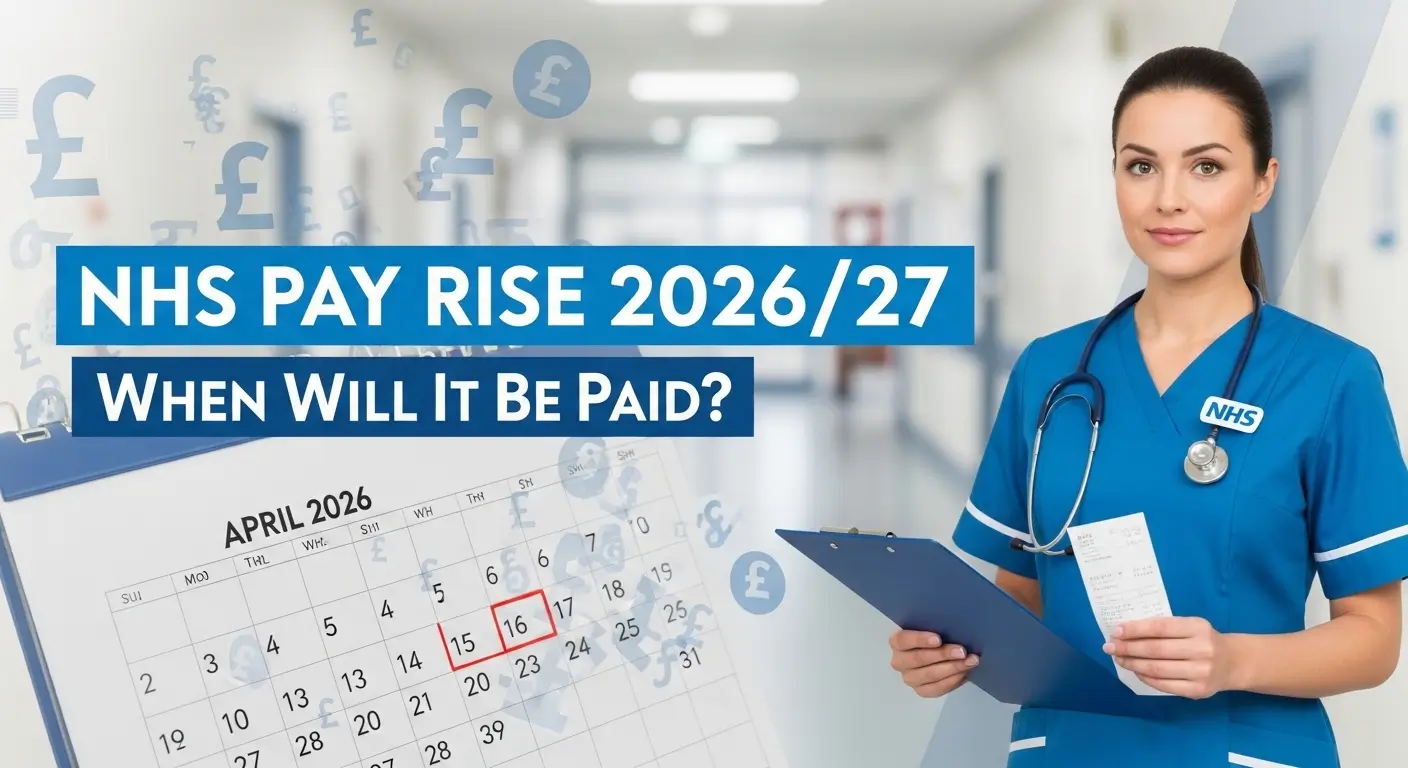
The NHS pay rise for 2026/27 will be paid at the end of April 2026 in your April payslip. The 3.3% increase was confirmed on 12 February 2026 and takes effect from 1 April 2026. This is the first on-time NHS pay award in six years — no backdating required.
If you work for the NHS and have been wondering when you’ll actually see more money in your bank account, you’re not alone. After years of delays and frustrating waits, this year is different. Let’s break down exactly when you’ll be paid and what you need to know.
Confirmed Payment Date: End of April 2026
The wait is over. Your 3.3% pay rise will land in your bank account at the end of April 2026.
The Electronic Staff Record (ESR) team — the system that handles NHS payroll — has confirmed that the increase will be applied to April salaries. This means when you check your April payslip, you should see your new, higher salary already in place.
Here’s what makes this year special:
- No waiting around. The Government announced the pay award on 12 February 2026 — a full two months before the new financial year starts.
- No complicated back pay. Because it’s being paid on time, you won’t need to wait for arrears or work out back-tax calculations.
- No uncertainty. ESR has already received the details and confirmed implementation.
For most NHS staff, payday falls in the last week of April. That’s when you’ll see the 3.3% increase reflected in your pay.
💡 Tip: Log into ESR self-service before April to check your current band and spine point. This makes it easy to verify the increase has been correctly applied when your April payslip arrives.
Key Dates Timeline for NHS Pay Rise 2026/27
Here’s the complete timeline so you know exactly what’s happening and when:
| Milestone | Date | Status |
|---|---|---|
| Government Announcement | 12 February 2026 | ✅ Confirmed |
| Pay Rise Effective From | 1 April 2026 | ✅ Confirmed |
| First Payment in Payslip | End of April 2026 | ✅ Confirmed |
| Backdating Required | None | ✅ On-time |
| Structural Reforms (if agreed) | Backdated to 1 April 2026 | 🔄 Negotiations ongoing |
Health Secretary Wes Streeting confirmed that the Government accepted the NHS Pay Review Body recommendations in full. In his statement, he said:
“We have listened to the workforce and understand the difficulties they face when pay awards are not delivered on time. That’s why this Government committed to speeding up the pay review process.”
The Government issued remit letters to the NHS Pay Review Body back in July 2025 — months earlier than previous years. They submitted written evidence by October 2025. This earlier start made on-time payment possible.
📌 Key Point: This is the first time in six years that Agenda for Change staff will receive their annual pay award on time, without delays or backdating.
When Will the NHS Pay Rise Be Paid by Region?
The NHS operates differently across the four UK nations. Here’s when staff in each region will receive their pay increase.
England — Paid April 2026
If you work for the NHS in England, you’ll receive the 3.3% increase in your end of April 2026 payslip.
The Department of Health and Social Care confirmed funding for the award as part of a £211 billion revenue budget for 2026-27. This represents a 4.5% cash increase on the previous year.
All Agenda for Change staff in England are covered, including:
- Nurses and midwives
- Healthcare assistants
- Paramedics and ambulance staff
- Allied health professionals
- Administrative and clerical staff
- Porters, domestic staff, and estates workers
Your employer’s payroll team will process the increase automatically through ESR. You don’t need to do anything.
Wales — Paid April 2026 (Same as England)
NHS Wales staff receive the same 3.3% increase on the same timeline as England.
Your pay rise will appear in your April 2026 payslip. The Welsh Government applies the same Agenda for Change framework, so there’s no difference in timing.
Cabinet Secretary for Health Jeremy Miles MS confirmed Wales would implement the pay award alongside England.
💡 Good to Know: Wales actually applies a 1.5% uplift on top of England rates, meaning all Welsh NHS pay points are slightly higher than those shown in standard AfC tables.
Scotland — Separate Deal (3.75%)
Important: This pay award does not apply to NHS Scotland in the same way.
NHS Scotland has separate pay arrangements. Scottish staff negotiated directly with the Scottish Government, and RCN members accepted a two-year NHS pay offer which included the 2026/27 award.
The good news? Scotland’s deal is actually higher at 3.75% — compared to 3.3% in England and Wales.
The timing is similar, with payment expected from April 2026, but you should confirm the exact date with your employer as Scotland doesn’t use the NHS Pay Review Body process.
🏴 For Scottish Staff: Your 3.75% increase was agreed as part of a two-year deal. Check with your employer for your exact payment date. You can also read our guide on Agenda for Change Scotland for more details.
Northern Ireland — April 2026 (With Caveats)
Northern Ireland staff are included in the 3.3% consolidated pay award from April 2026.
The Minister of Health has committed to implementing an “interim downpayment” for Health and Social Care staff from 1 April 2026. This shows intent to avoid the delays that have affected NI staff in previous years.
However, the Royal College of Nursing has noted they are “seeking clarity to confirm when the recommended award will be paid” due to funding challenges. Northern Ireland’s Department of Health funding settlement for 2026-27 represents just a 0.9% increase to £8.5 billion — much tighter than England’s allocation.
⚠️ Northern Ireland Staff: While the award is confirmed, keep an eye on announcements from your employer regarding exact payment timing.
Why Is the NHS Pay Rise On Time This Year?
For six consecutive years, NHS staff endured delayed pay awards. You’d hear an announcement, then wait months before seeing anything in your bank account. The frustration of backdating, complex arrears calculations, and financial uncertainty became the norm.
The 2026/27 award breaks this pattern. Here’s why:
| Reason | What Changed |
|---|---|
| Earlier Remit Letters | Government issued remit letters to the NHS Pay Review Body in July 2025 — months earlier than previous years |
| Faster Evidence Submission | The Department of Health and Social Care and NHS England submitted written evidence by October 2025 |
| February Announcement | The award was confirmed on 12 February 2026 — two full months before the financial year starts |
| ESR Preparation Time | Electronic Staff Record teams had enough lead time to update payroll systems |
Let’s look at how this compares to recent years:
| Year | When Announced | When Paid | Delay |
|---|---|---|---|
| 2023-24 | After industrial action | Backdated months later | Significant |
| 2024-25 | March 2025 | Paid later | Backdating required |
| 2025-26 | May 2025 | August 2025 | 4+ months |
| 2026-27 | February 2026 | April 2026 | None — on time |
After years of feeling like an afterthought, this represents genuine progress. The earlier timeline shows what’s possible when the pay review process is prioritised.
📌 Key Point: The 2026/27 award is being paid on time because the Government started the process earlier. Remit letters went out in July 2025, evidence was submitted by October 2025, and the announcement came in February 2026.
What If My Trust Is Late Processing the Pay Rise?
You might be worried that even though the pay award is confirmed, your employer could be slow to update their systems. Here’s what you need to know.
The vast majority of NHS organisations use the Electronic Staff Record system for payroll. ESR has already confirmed the increase will be applied to April salaries. This means the update happens centrally and automatically — your Trust doesn’t need to manually input new figures.
Here’s what happens in different scenarios:
| Situation | What Happens |
|---|---|
| ESR employer, on time | New rate appears in your April payslip |
| ESR employer, slight delay | Arrears backdated to 1 April 2026 |
| Non-ESR employer | Contact HR — arrears will be backdated |
| Agency/Bank staff | Check with your agency — AfC rates apply to substantive roles |
You don’t need to take any action to receive the increase. It will be processed automatically. If there’s any delay on your employer’s end, you’re entitled to arrears backdated to 1 April 2026. Use our NHS back pay calculator to work out any owed amounts.
💡 Tip: Check your April payslip carefully. Your annual salary should reflect the 3.3% increase. If it doesn’t, contact your payroll department — you’re entitled to the backdated amount.
Does the NHS Pay Rise Apply to Nurses?
Yes. All nurses employed on Agenda for Change contracts receive the 3.3% increase in their April 2026 payslip.
But there’s more good news for nurses this year. Beyond the standard pay rise, the Government has announced additional support specifically for nursing staff:
| Benefit | Details |
|---|---|
| Mandatory Role Reviews | Every Band 5 nurse in NHS England will have their role reviewed by their employer |
| Potential Regrading | If you’re working above Band 5 level, you’ll be regraded to the appropriate band |
| Backdated Pay | Any resulting pay increases will be backdated to 1 April 2026 |
| Separate Funding | Additional funding has been provided — this doesn’t come from the 3.3% award |
| Board Oversight | Board-level oversight is required to ensure reviews happen on time |
This is significant. The Royal College of Nursing noted this is “the first time nursing has been prioritised in this way.”
Professor Nicola Ranger, RCN General Secretary and Chief Executive, acknowledged the structural improvements while expressing concern that the 3.3% award itself falls below current inflation levels.
👩⚕️ For Band 5 Nurses: Talk to your line manager about the role review process. If you believe you’re working above Band 5 level, this review could result in regrading to Band 6 and additional pay backdated to April.
What About AfC Structural Reforms and Additional Pay?
Beyond the 3.3% consolidated increase, the Government has committed to funded improvements to the Agenda for Change pay structure. These are being negotiated through the NHS Staff Council.
Here’s what’s on the table:
| Reform Priority | Status |
|---|---|
| Raising pay for the lowest bands | Under discussion |
| Improving graduate pay across professions | Under discussion |
| Pay progression within bands | Under discussion |
| Promotion incentives | Under discussion |
These reforms are expected to be agreed upon during 2026-27. The important point is that once agreed, any resulting pay increases will be backdated to 1 April 2026.
The Government has committed separate additional funding for these reforms. They won’t come out of existing NHS budgets, which means they’re genuinely additional — not just moving money around.
The negotiations involve:
- NHS Staff Council (representing trade unions and employers)
- Department of Health and Social Care (England)
- Department of Health (Northern Ireland)
- Welsh Government
📌 Key Point: Structural reforms could mean extra pay on top of the 3.3% for some staff. Watch for announcements from your union and employer during 2026-27. This is particularly relevant for staff in the lowest pay bands and Band 3.
Frequently Asked Questions
When will I see the NHS pay rise in my bank account?
You will see the 3.3% increase in your end-of-April 2026 pay. The exact date depends on your employer’s pay date, but for most NHS staff this is the last working day of April.
Is the NHS pay rise 2026/27 definitely confirmed?
Yes. Health Secretary Wes Streeting announced on 12 February 2026 that the Government accepted the NHS Pay Review Body recommendations in full. The Electronic Staff Record system has confirmed the increase will be applied to April salaries.
Will the NHS pay rise be backdated?
No backdating is required this year. The award was announced in February and takes effect from 1 April 2026, meaning it will be paid on time in April. However, if your employer’s payroll processes the increase late, you’ll receive arrears backdated to 1 April. You can use our back pay calculator to estimate any owed amounts.
When will NHS Wales staff receive the pay rise?
NHS Wales staff receive the same 3.3% increase on the same timeline as England — paid in April 2026 payslips. The Welsh Government applies the same Agenda for Change framework.
When will NHS Scotland staff receive their pay rise?
NHS Scotland operates under a separate pay arrangement. Scottish staff received a 3.75% increase as part of a two-year deal already accepted by unions. Payment timing is similar (from April 2026) but confirm with your employer. See our Agenda for Change Scotland guide for details.
When will NHS Northern Ireland staff be paid?
Northern Ireland staff are included in the 3.3% award from April 2026. However, the RCN has noted they are “seeking clarity to confirm when the recommended award will be paid” due to funding challenges in the region.
Does this apply to part-time NHS staff?
Yes. Part-time staff receive the same 3.3% increase applied to their pro-rata salary. The payment date is the same — April 2026. Use our NHS take-home pay calculator to see your exact new salary.
Does this apply to Bank and Agency staff?
Bank staff paid on Agenda for Change rates will see the increase. Agency staff should check with their agency, as rates depend on individual contracts.
What about NHS pension — does that increase too?
This guide covers the Agenda for Change pay rise for current NHS staff. NHS Pension increases for retirees are handled separately through a different process. Your pension contributions may also change based on your new salary tier.
Calculate Your New Take-Home Pay
Now you know when you’ll be paid, you probably want to know exactly how much you’ll take home after tax, National Insurance, and pension contributions.
The 3.3% increase means different amounts depending on your band:
- Band 2 staff will see approximately £70 more per month
- Band 3 staff will see approximately £71 more per month
- Band 5 staff will see approximately £82 more per month
- Band 6 staff will see approximately £110 more per month
- Band 7 staff will see approximately £135 more per month
Use our NHS Take Home Pay Calculator to see your exact new salary after all deductions. You can also view the complete NHS pay bands 2026/27 to see where you sit on the pay scale, or check the hourly rates for 2026/27 if you work variable hours.
Summary: Key Facts About NHS Pay Rise Payment Date
| What You Need to Know | Answer |
|---|---|
| When will it be paid? | End of April 2026 |
| Which payslip? | April 2026 |
| Is it confirmed? | Yes — announced 12 February 2026 |
| Is there back pay? | No — paid on time |
| Does it apply to all regions? | England ✓ Wales ✓ Scotland (separate) NI ✓ |
| Do I need to do anything? | No — automatic via ESR |
For the first time in six years, NHS staff can plan their finances with confidence. The 3.3% pay rise is confirmed, ESR is ready, and the money will be in your account at the end of April.
After years of uncertainty, that’s progress worth recognising.