How Does NHS Maternity Pay Work?
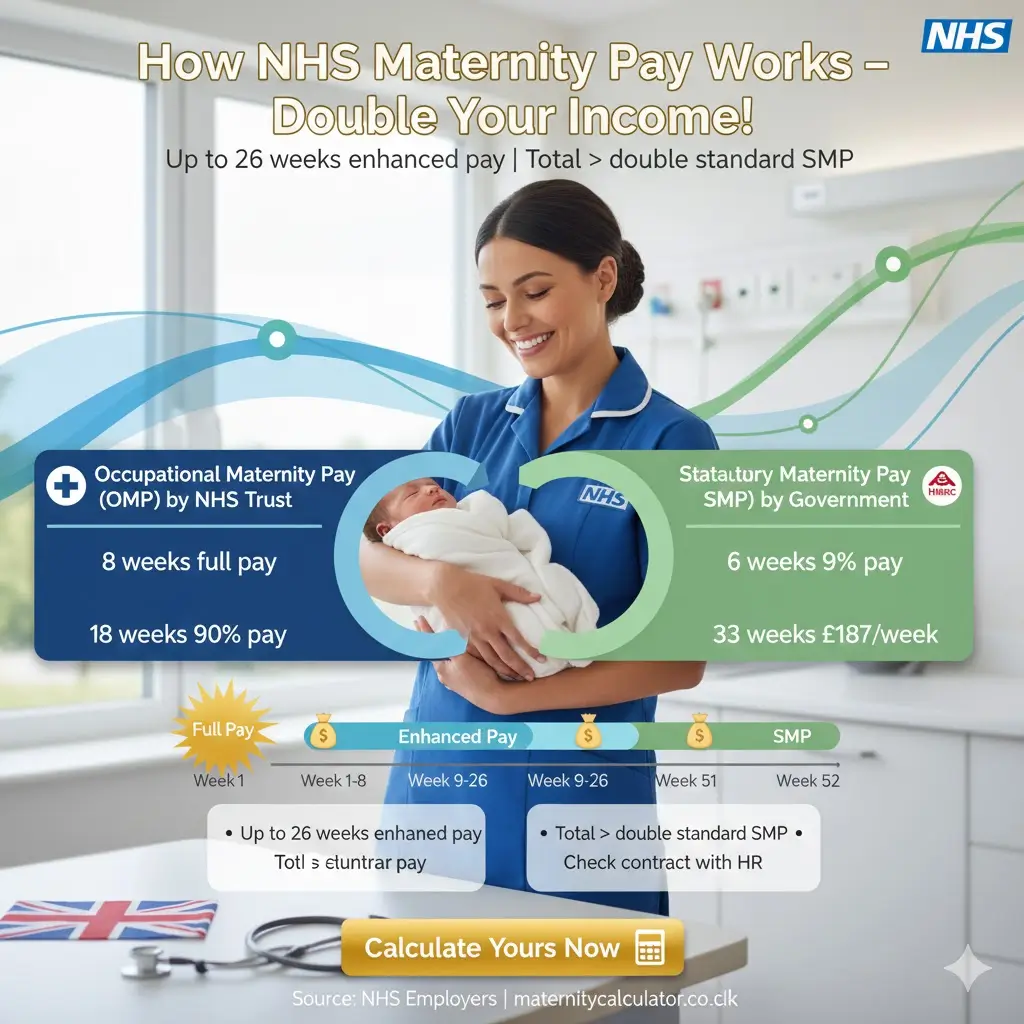
NHS employees receive significantly enhanced maternity benefits compared to standard Statutory Maternity Pay through the Agenda for Change framework. Your total entitlement combines two distinct payment streams: Occupational Maternity Pay (OMP) provided directly by your NHS Trust employer and Statutory Maternity Pay (SMP) funded by the government through HMRC.
Understanding this dual payment structure is essential for accurate financial planning. Unlike standard employers who typically provide only SMP, the NHS offers a generous occupational scheme that can more than double your maternity income during the first 26 weeks of leave.
“Occupational Maternity Pay (OMP) is the pay you receive that is provided by your employer (the NHS) during maternity leave. To be sure you qualify for OMP, you should check your employment contract or contact your HR department” [source: maternitycalculator.co.uk]
NHS Maternity Pay Structure: Complete 52-Week Breakdown
| Payment Phase | Duration | What You Receive | Typical Band 5 Weekly Net |
| Full Pay | Weeks 1-8 | 100% salary (inclusive of SMP) | ~£440 |
| Half Pay + SMP | Weeks 9-26 | 50% salary plus SMP (capped at full pay) | ~£370 |
| SMP Only | Weeks 27-39 | £187.18/week or 90% AWE (lower amount) | ~£150 |
| Unpaid Leave | Weeks 40-52 | £0 | £0 |
This structure means eligible NHS staff receive 39 weeks of paid maternity leave followed by 13 weeks of unpaid additional maternity leave if desired.
Critical clarification: During weeks 1-8, full pay is inclusive of SMP — meaning SMP is offset within your full salary, not added on top. During weeks 9-26, half pay plus SMP is capped at your rate of full pay to prevent overpayment.
Read Guide: NHS Pay Bands 2025/26
Statutory Maternity Pay Rates 2025/26 (Confirmed)
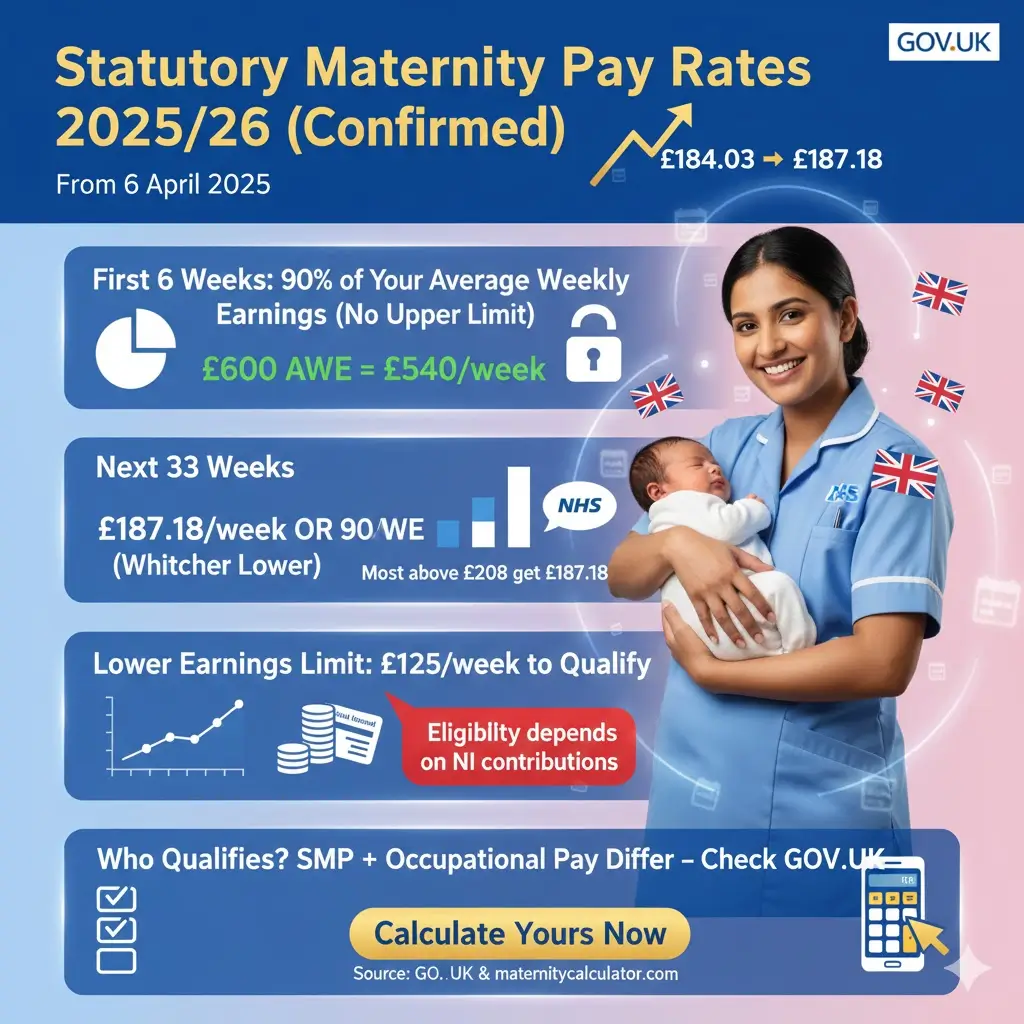
From 6 April 2025, Statutory Maternity Pay rates are officially confirmed by GOV.UK:
“From Sunday 6 April 2025, Statutory Maternity Pay increases from £184.03 to £187.18 per week” [source: maternitycalculator.co.uk]
Read Guide: NHS Band 5 Pay 2025/26
First 6 Weeks of SMP
90% of your Average Weekly Earnings with no upper limit.
“90% of the employee’s average weekly earnings for the first 6 weeks” [source: GOV.UK]
If your AWE is £600, you receive £540 weekly. No cap applies during this period.
Remaining 33 Weeks of SMP
£187.18 per week OR 90% of AWE — whichever amount is lower.
“£187.18 or 90% of their average weekly earnings (whichever is lower) for the remaining weeks” [source: GOV.UK]
Most NHS employees earning above £208/week receive the flat rate of £187.18.
Lower Earnings Limit 2025/26
“The Lower Earnings Limit for 2025 to 2026 is £125” [source: GOV.UK]
You must earn at least £125 per week on average to qualify for SMP. This is the threshold for Class 1 National Insurance contributions liability.
Who Qualifies for NHS Maternity Pay?
Eligibility requirements differ between Occupational Maternity Pay and Statutory Maternity Pay. Understanding both criteria ensures you know exactly what payments to expect.
Read Guide: NHS Band 6 Pay 2025/26
Statutory Maternity Pay (SMP) Eligibility Requirements
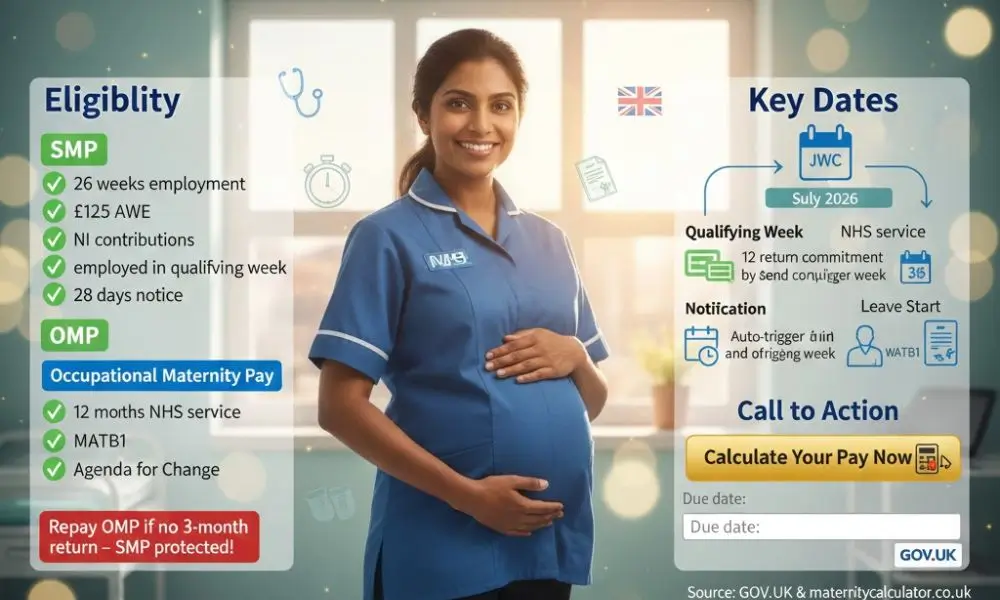
You qualify for SMP if you meet all these conditions [source: GOV.UK]:
- 26 weeks of continuous employment by the end of the qualifying week (15th week before your due date)
- Average Weekly Earnings of £125 or more during the relevant period
- Earnings liable to Class 1 National Insurance contributions or would be if high enough
- Still employed in the qualifying week (even if only for one day)
- Provide your MATB1 certificate to your employer
- Give proper notice at least 28 days before starting SMP
“Average weekly earnings must include all earnings on which Class 1 National Insurance contributions are due, or would be due if they were high enough” [source: GOV.UK]
Read Guide: NHS Band 7 Pay 2025/26
Occupational Maternity Pay (OMP) Eligibility Requirements
NHS Occupational Maternity Pay requires:
- 12 months continuous NHS service by the 11th week before your expected week of childbirth
- Written intention to return to NHS employment for at least 3 months after maternity leave
- Employment under Agenda for Change terms and conditions
“This calculator is based on the most common plan provided to NHS employees: 8 weeks full pay and 18 weeks half pay” [source: maternitycalculator.co.uk]
Critical warning: If you do not return to the NHS for at least 3 months, you may be required to repay your Occupational Maternity Pay in full. Only SMP is protected from repayment regardless of whether you return.
Understanding Your Key Maternity Dates
Your maternity pay calculation depends on several critical dates. Our NHS Maternity Pay Calculator automatically determines these from your baby’s due date using official GOV.UK methodology.
Read Guide: NHS Band 3 Pay 2025/26
Expected Week of Childbirth (EWC)
The Expected Week of Childbirth runs from the Sunday before your due date to the following Saturday.
“EWC stands for ‘Expected Week of Childbirth.’ It normally starts from the Sunday before the expected date of birth” [source: Zelt]
Example: If your due date is Wednesday, 15th July 2026, your EWC runs from Sunday,y 12th July to Saturday, 18th July 2026.
Qualifying Week
The qualifying week is the 15th week before your EWC — the critical assessment point for eligibility and AWE calculation.
“The qualifying week is the 15th week before your baby is due” [source: Contend Legal]
Read Guide: NHS Band 2 Pay 2025/26
The Relevant Period for AWE Calculation
Your employer calculates AWE based on earnings during the relevant period:
“The end of the relevant period is the last normal payday on or before the Saturday of the qualifying week. The start of the relevant period is the day after the last normal payday falling at least 8 weeks before the end of the relevant period” [source: GOV.UK]
Notification Deadline
You must inform your employer in writing by the end of the qualifying week (15 weeks before your due date). Your notification should include:
- Confirmation that you are pregnant
- Your expected week of childbirth
- The date you want maternity leave to start
Earliest Maternity Leave Start Date
Maternity leave can begin up to 11 weeks before your due date at the earliest.
Automatic trigger: If you are off work with a pregnancy-related illness during the 4 weeks before your due date, your maternity leave automatically begins the following day.
MATB1 Certificate
Your midwife or GP provides the MATB1 maternity certificate after 20 weeks of pregnancy.
“Information you need to work out your employee’s Statutory Maternity Pay: the date the baby’s due — from your employee’s MATB1 form” [source: GOV.UK]
How to Calculate Average Weekly Earnings (AWE): Complete Guide
Your Average Weekly Earnings determine both your SMP eligibility and the amount you receive during the first six weeks. GOV.UK provides exact calculation methods for each pay frequency.
Critical rule from GOV.UK: “Do not round the figure up or down to whole pence”
AWE Calculation for Monthly Paid NHS Staff
GOV.UK provides this exact formula:
“Add up all the earnings paid between [relevant period dates]: divide by 2 (number of months in the relevant period), multiply by 12 (number of months in the year), divide by 52 (number of weeks in the year)” [source: GOV.UK]
Step-by-step calculation:
- Add gross pay from 2 monthly payslips in the relevant period
- Divide the total by 2
- Multiply by 12
- Divide by 52
- Do not round the result
Example calculation:
- Month 1 gross pay: £2,200
- Month 2 gross pay: £2,200
- Total: £4,400
- Divided by 2 = £2,200
- Multiplied by 12 = £26,400
- Divided by 52 = £507.6923076923 AWE (use full precision)
AWE Calculation for Weekly Paid Staff
“Add up all the earnings paid between [relevant period dates] and divide by 8 (the number of weeks in the relevant period)” [source: GOV.UK]
Example from GOV.UK: If the baby is due on 23 March 2025 and paid weekly on Fridays:
- Qualifying week: 1-6 December 2024
- Relevant period: 12 October 2024 to 6 December 2024
- Add all earnings in this period and divide by 8
AWE for Irregular Pay or Mistimed Payments
“Divide the total earnings in the relevant period by the number of weeks’ wages actually paid” — use actual weeks paid, not assumed 8 weeks [source: GOV.UK]
Overpaid or Underpaid Earnings
“Always calculate average weekly earnings based on all earnings actually paid to the employee within the relevant period, regardless of any over- or underpaid wages in that period” [source: GOV.UK]
What Counts Toward Your AWE
Included in AWE calculation (earnings liable to Class 1 NI):
- Basic salary
- Overtime payments
- Bonuses paid in the relevant period
- London weighting and high-cost area supplements
- Statutory Sick Pay
- Holiday pay
- Shift premiums and unsocial hours payments
- Arrears of pay
Not included in AWE:
- Expense reimbursements
- Benefits in kind
- Redundancy payments
How Salary Sacrifice Affects Your AWE
If you participate in salary sacrifice schemes (childcare vouchers, cycle to work, additional pension contributions), these deductions reduce your gross pay and therefore your AWE.
Critical warning: Lower AWE could push you below the £125 Lower Earnings Limit, making you ineligible for SMP entirely. Consider temporarily opting out before your qualifying week.
The Spread OMP Payment Option Explained
NHS employees can request to spread their Occupational Maternity Pay evenly over 52 weeks rather than receiving higher amounts during weeks 1-26.
“If you request to average out your Occupational Maternity Pay, you will receive your payments spread out evenly over the maximum of 52 weeks’ leave. Statutory Pay cannot be spread out and will begin 8 weeks after your leave starts” [source: maternitycalculator.co.uk]
How Spread Payments Work
| Standard OMP | Spread OMP (52 weeks) |
| Weeks 1-8: Full pay | Weeks 1-52: Even weekly OMP amount |
| Weeks 9-26: Half pay + SMP | SMP starts week 9 (cannot be spread) |
| Weeks 27-39: SMP only | |
| Weeks 40-52: Unpaid | Weeks 40-52: OMP portion continues |
Critical point: Statutory Maternity Pay cannot be spread. When you choose spread OMP, SMP begins 8 weeks after your leave starts, rather than immediately.
Who Benefits from Spread Payments?
Spreading your OMP may suit you if:
- You wanta consistent monthly income throughout 52 weeks
- You plan to take the full year of maternity leave
- Budgeting with variable income feels stressful
- Your household depends on a predictable cash flow
Request spread payments through your NHS Trust HR department before your maternity leave begins.
SMP Calculation Examples (GOV.UK Methodology)
Example 1: Higher Earner
If your average weekly earnings are £350 [source: Contend Legal]:
Weeks 1-6: 90% of £350 = £315 per week
Weeks 7-39: 90% of £350 = £315, but statutory rate is £187.18 Since £315 > £187.18, you receive £187.18 per week
Total SMP:
- First 6 weeks: £315 × 6 = £1,890
- Next 33 weeks: £187.18 × 33 = £6,176.94
- Total: £8,066.94
Example 2: Lower Earner
If your average weekly earnings are £200 [source: Contend Legal]:
Weeks 1-6: 90% of £200 = £180 per week
Weeks 7-39: 90% of £200 = £180, statutory rate is £187.18 Since £180 < £187.18, you receive £180 per week
Total SMP:
- First 6 weeks: £180 × 6 = £1,080
- Next 33 weeks: £180 × 33 = £5,940
- Total: £7,020
What If You Don’t Qualify for SMP? Maternity Allowance Alternative
If you’re ineligible for Statutory Maternity Pay, you may qualify for Maternity Allowance instead.
Maternity Allowance Eligibility
“Your payment is based on your average weekly earnings over any 13 weeks in the 66 weeks before your baby is due. You can choose your highest-earning 13 weeks (they don’t have to be consecutive) to maximise your allowance” [source: govexplained.co.uk]
You may qualify if:
- You’ve been employed or self-employed for at least 26 weeks in the 66 weeks before your due date
- You earned at least £30 per week for 13 of those weeks
- You don’t qualify for SMP from any employer
Maternity Allowance Rates 2025/26
| Claimant Type | Weekly Amount | Duration |
| Employed/self-employed meeting full conditions | Up to £187.18 | 39 weeks |
| Earning between £30 and £187.17/week | 90% of AWE | 39 weeks |
| Self-employed with insufficient Class 2 NI | £27 | 39 weeks |
“For 2024/25 (still current for 2025), you can receive up to £184.03 a week for a maximum of 39 weeks” — Note: This increases to £187.18 from April 2025 [source: govexplained.co.uk]
Maternity Allowance Example
“Leanne worked part-time for 40 of the 66 qualifying weeks and earned an average of £150 per week. She’ll get 90% of her weekly earnings (£135) for 39 weeks. Her total Maternity Allowance will be £5,265” [source: govexplained.co.uk]
Apply through Jobcentre Plus or GOV.UK uses form MA1 from 26 weeks of pregnancy.
Understanding Tax and Deductions on Maternity Pay
Both Occupational Maternity Pay and Statutory Maternity Pay are subject to standard payroll deductions.
Income Tax
Maternity pay is taxed through PAYE like a regular salary. The 2025/26 Personal Allowance is £12,570 (£241.73/week).
During lower-paid SMP-only weeks, you may receive refunds of overpaid tax from higher-earning months.
National Insurance Contributions
National Insurance on earnings liable to Class 1 contributions applies at:
- 8% on earnings between £242 and £967 per week
- 2% on earnings above £967 per week
During SMP-only weeks (£187.18), you fall below the Primary Threshold and pay no NI.
NHS Pension Contributions
Your contribution rate depends on pensionable pay (2025/26 rates):
| Annual Pensionable Pay | Contribution Rate |
| Up to £13,245 | 5.1% |
| £13,246 – £23,759 | 5.2% |
| £23,760 – £43,805 | 6.5% |
| £43,806 – £49,245 | 8.3% |
| £49,246 – £61,207 | 9.8% |
| £61,208 – £68,523 | 10.0% |
| £68,524 – £79,574 | 11.6% |
| £79,575+ | 12.5% |
Keeping In Touch (KIT) Days Explained
KIT days allow you to work up to 10 days during maternity leave without ending your leave or losing SMP.
How KIT Days Work
- Completely voluntary — employer cannot require you to work
- Paid at your normal daily rate
- Any work counts as a full KIT day, even one hour
- Working more than 10 days ends your SMP entitlement
Effective Uses for KIT Days
- Mandatory training and revalidation
- Team meetings and handovers
- Maintaining clinical skills
- Interviewing for promotions
Regional NHS Maternity Calculators
NHS Scotland
“Use this calculator to work out your maternity leave dates and your eligibility for Statutory Maternity Pay and Occupational Maternity Pay” [source: workforce.nhs.scot]
Access at: workforce.nhs.scot/calculators/maternity-leave-calculator/
GOV.UK Official Calculator
“Calculate your employee’s: Statutory Maternity Pay (SMP), paternity pay, adoption pay; relevant employment period and average weekly earnings; leave period” [source: GOV.UK]
Frequently Asked Questions
What is the SMP rate from April 2025?
“From Sunday 6 April 2025, Statutory Maternity Pay increases from £184.03 to £187.18 per week” [source: maternitycalculator.co.uk]
What is the Lower Earnings Limit for 2025/26?
“The Lower Earnings Limit for 2025 to 2026 is £125” [source: GOV.UK]
How is SMP calculated for the first 6 weeks?
“90% of the employee’s average weekly earnings for the first 6 weeks” [source: GOV.UK]
How is SMP calculated for weeks 7-39?
“£187.18 or 90% of their average weekly earnings (whichever is lower) for the remaining weeks” [source: GOV.UK]
Should I round my AWE calculation?
“Do not round the figure up or down to whole pence” [source: GOV.UK]
Can I spread my NHS maternity pay?
“If you request to average out your Occupational Maternity Pay, you will receive your payments spread out evenly over the maximum of 52 weeks’ leave. Statutory Pay cannot be spread out and will begin 8 weeks after your leave starts” [source: maternitycalculator.co.uk]
What NHS maternity pay structure is most common?
“This calculator is based on the most common plan provided to NHS employees: 8 weeks full pay and 18 weeks half pay” [source: maternitycalculator.co.uk]
How long do I need to work to qualify for SMP?
You must have worked for your employer for 26 weeks by the qualifying week (15th week before the due date) and earn at least £125/week on average.
What if I don’t qualify for SMP?
You may qualify for Maternity Allowance — up to £187.18/week for 39 weeks. You can choose your highest-earning 13 weeks from the 66 weeks before your due date.
Do I have to repay maternity pay if I don’t return to the NHS?
You may need to repay Occupational Maternity Pay if you don’t return for 3+ months. Statutory Maternity Pay never needs to be repaid.
Official Resources and Further Reading
- GOV.UK Statutory Maternity Pay Manual Calculation — gov.uk/guidance/statutory-maternity-pay-manually-calculate-your-employees-payments
- GOV.UK Maternity Calculator — gov.uk/maternity-paternity-calculator
- NHS Scotland Maternity Calculator — workforce.nhs.scot/calculators/maternity-leave-calculator/
- NHS Maternity Pay Calculator — maternitycalculator.co.uk
- Maternity Allowance Guide — govexplained.co.uk/money-and-benefits/maternity-allowance/
This NHS Maternity Pay Calculator uses official GOV.UK methodology with confirmed 2025/26 rates: SMP £187.18/week, Lower Earnings Limit £125/week (from 6 April 2025). NHS OMP follows standard Agenda for Change terms (8 weeks full pay + 18 weeks half pay). Full pay is inclusive of SMP; half pay + SMP is capped at the full pay rate. Individual Trust policies may vary — verify with your HR department. All calculations follow GOV.UK guidance: do not round AWE figures. Sources: GOV.UK, NHS Scotland workforce.nhs.scot, maternitycalculator.co.uk, govexplained.co.uk.