Smart NHS Pay Rise Calculator 2026/27
NHS Pay Rise Calculator 2026/27 — instantly see how the 3.3% NHS pay rise affects your take-home pay. Our free NHS take home pay calculator shows exact deductions for tax, National Insurance, pension, and student loans across all pay bands (2-9) for England, Scotland, Wales, and Northern Ireland. Whether you're a nurse, healthcare assistant, or allied health professional, calculate your new salary in seconds. Toggle "Show Pay Rise" to compare your 2025/26 vs 2026/27 earnings instantly.
Guide prices - check official NHS 2026/27 pay tables for exact figures.
How to Use This NHS Salary Calculator
The NHS salary calculator processes four critical data points to generate accurate take-home pay estimates for healthcare workers under the Agenda for Change framework.
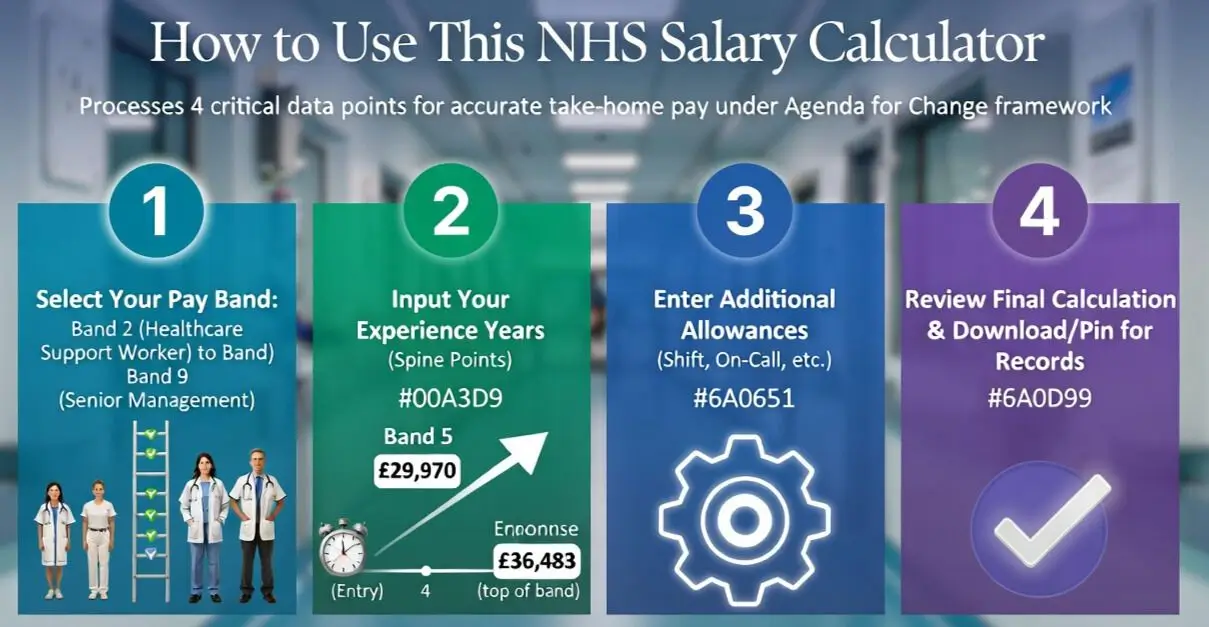
Step 1:
Select Your Pay Band: Choose your current NHS pay band from Band 2 (Healthcare Support Worker) through Band 9 (Senior Management). Each band contains multiple spine points reflecting years of service and progression.
Step 2:
Input Your Experience Years (Spine Points) Your position within a pay band determines your base salary. Entry-level positions start at the lowest spine point, advancing annually until reaching the band maximum. Band 5 nurses, for example, progress from £29,970 (entry) to £36,483 (experienced) over 4 years.
Step 3:
Adjust for Working Hours (FTE) Full-Time Equivalent (FTE) represents your contracted hours. A 1.0 FTE equals 37.5 hours weekly. Part-time staff working 30 hours weekly have 0.8 FTE. The calculator adjusts gross pay proportionally: Annual Salary × FTE = Actual Gross Pay.
Step 4:
Review Pension Contribution. The NHS Pension Scheme deducts contributions before tax calculation. Your contribution rate depends on pensionable earnings, ranging from 5.2% to 12.5%. These rates increased alongside the 2024 pay award to prevent bracket creep.
The 2024/25 Pay Award Calculation Logic
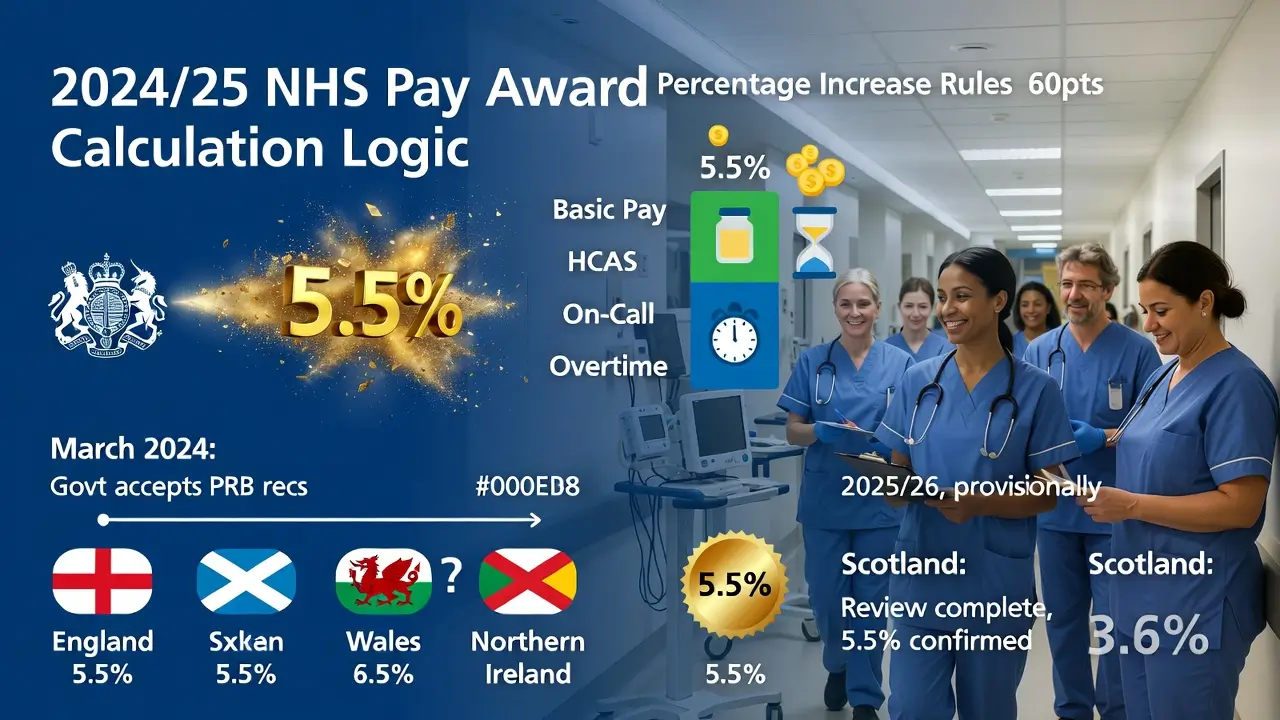
The government accepted the NHS Pay Review Body recommendations in March 2024, confirming differentiated percentage increases across pay bands.
The Percentage Increase (5.5% / 3.6% Rules)
The 2024/25 pay deal applies a 5.5% consolidated increase to all Agenda for Change staff in England. This percentage applies to:
- Basic pay (excluding London weighting)
- High-cost area supplements (HCAS)
- On-call allowances
- Overtime rates
Scotland received 5.5% through separate negotiations. Wales implemented 5% initially with potential top-up pending. Northern Ireland follows England’s 5.5% structure.
For 2025/26, provisional agreements indicate a 3.6% uplift, though formal confirmation awaits the spring Pay Review Body report.
Impact of National Insurance & Tax Codes (1257L)
Your take-home pay depends on three deductions applied in sequence:
Pension Contribution: Calculated first on gross pay. A Band 5 nurse earning £31,469 pays 8.3% (£2,612 annually).
Income Tax: Applied to earnings above £12,570 (standard 1257L tax code). The 20% basic rate applies up to £50,270. Higher earners face 40% on amounts exceeding this threshold.
National Insurance: 12% on earnings between £12,570-£50,270 (reducing to 2% above). The April 2024 reduction from 12% to 10% increased all NHS take-home pay by approximately £75 monthly for full-time staff.
NHS Backpay Calculator: Estimating Arrears
Backdated pay creates a one-off lump sum payment when implementation delays occur after the April effective date.
The arrears calculation follows this formula: (New Monthly Gross – Previous Monthly Gross) × Months Elapsed = Backpay Amount
Example Calculation:
- Band 3 Healthcare Assistant previous salary: £24,336 annually (£2,028 monthly)
- New 5.5% increased salary: £25,674 annually (£2,139.50 monthly)
- Monthly difference: £111.50
- Implementation in August (4 months backdated): £111.50 × 4 = £446 gross backpay
This lump sum appears as “Arrears of Pay” on your payslip. Tax and National Insurance apply at your standard rate, potentially pushing that month into a higher tax bracket temporarily.
Important: Pension contributions also apply retrospectively, increasing your pensionable service credit.
2025 NHS Pension Contribution Tiers (Updated)
The NHS Pension Scheme contribution rates align with pay increases to prevent unintended tier jumping.
|
Pensionable Pay (Annual) |
Member Contribution Rate |
Monthly Deduction (FTE 1.0) |
|
Up to £13,259 |
5.2% |
£57.46 maximum |
|
£13,260 to £27,797 |
6.5% |
£71.82 – £150.48 |
|
£27,798 to £33,868 |
8.3% |
£192.32 – £234.27 |
|
£33,869 to £50,845 |
9.8% |
£276.48 – £415.20 |
|
£50,846 to £65,190 |
10.7% |
£453.36 – £581.28 |
|
£65,191 and above |
12.5% |
£679.07+ |
These tiers increased 5.5% in April 2024. The 2025/26 adjustment will add another 3.6%, protecting members from contribution increases solely due to pay awards.
Overtime and Bank Shifts: Pensionable for contribution calculation but don’t count toward final salary benefits.
Pay Band Breakdowns: What is the Take-Home Pay?
Real-world take-home calculations for common NHS positions (England, 2024/25 rates, standard tax code, no student loan).
Band 2 & 3 (Healthcare Assistants / Entry)
Band 2 Healthcare Support Worker
- Gross Annual: £23,615 (entry point)
- After 5.5% rise: £24,914
- Monthly Gross: £2,076
- Pension (6.5%): -£135
- Tax (20% on £12,344): -£206
- National Insurance: -£122
- Monthly Take-Home: £1,613
The Band 2 entry point now exceeds the Real Living Wage (£11.44/hour) at £11.96/hour, eliminating the need for temporary supplements.
Band 3 Admin/Clerical
- Gross Annual: £24,336-£26,282 (2-year progression)
- After rise: £25,674-£27,727
- Typical Take-Home: £1,680-£1,790 monthly
Band 5 (Nurses & Midwives)
Newly Qualified Band 5 Nurse
- Starting Gross: £29,970
- After 5.5% rise: £31,618
- Monthly Gross: £2,635
- Pension (8.3%): -£219
- Tax: -£313
- National Insurance: -£164
- Monthly Take-Home: £1,939
Experienced Band 5 (Top of Band)
- Gross: £36,483 rising to £38,489
- Monthly Take-Home: £2,298
Band 5 staff reaching 2+ years service progress automatically unless performance issues exist.
Band 6 & 7 (Specialists & Senior Staff)
Band 6 Specialist Nurse/Senior Radiographer
- Salary Range: £37,338-£44,962
- After rise: £39,391-£47,435
- Take-Home Range: £2,340-£2,720 monthly
Band 7 Advanced Practitioner/Ward Manager
- Salary Range: £45,839-£53,219
- After rise: £48,360-£56,146
- Pension jumps to 9.8% at £50,846
- Take-Home Range: £2,750-£3,140 monthly
London weighting adds 20% (Inner), 15% (Outer), or 5% (Fringe) subject to minimum/maximum thresholds.
Frequently Asked Questions
When will the NHS pay rise be paid?
The 2024/25 pay rise takes effect from April 1, 2024. Most NHS trusts implement changes between June and August, paying arrears in a lump sum. Check your trust’s intranet for specific payment dates.
Will I get a lump sum payment in 2024/25?
Yes, if your trust implements the pay award after April 2024. The lump sum equals the difference between old and new pay, multiplied by the months waited. Unlike 2023’s non-consolidated bonus, this forms part of your permanent salary increase.
How does overtime affect my pension?
Overtime payments increase your pension contributions (calculated on total pensionable pay) but don’t increase your final pension benefits in the Career Average scheme. Regular overtime workers should factor the additional 5.2%-12.5% deduction when calculating hourly rates.
Do agency and bank staff receive the pay rise?
Agency workers’ rates depend on framework agreements, not AfC scales. NHS Professionals (bank staff) rates typically increase 3-6 months after substantive staff rises. Locum doctors negotiate rates individually.
What about the 2025/26 pay rise?
The provisional 3.6% increase for 2025/26 awaits formal Pay Review Body recommendations in March 2025. Implementation would follow the same April-August pattern as previous years.
How accurate is this calculator?
The calculator provides estimates using standard tax codes and contribution rates. Actual take-home varies based on:
- Tax code adjustments (marriage allowance, company car)
- Student loan deductions (Plan 1, 2, or postgraduate)
- Salary sacrifice schemes (lease cars, cycle-to-work)
- Additional pension contributions (AVCs)
- High-cost area supplements (London/fringe)
For exact figures, consult your ESR payslip or trust’s payroll department.