Calculate your exact entitlement and pay dates with our advanced NHS Sick Pay Calculator. Updated for 2025/26, this tool handles Section 14 enhancements and complex rolling 12-month logic. We factor in tax, 2025/26 pension tiers, and 28-week SSP limits to reveal your true net take-home pay during illness.
How Does NHS Sick Pay Work?
NHS occupational sick pay provides essential income protection when illness prevents you from working. Unlike basic Statutory Sick Pay (SSP), NHS sick pay through Agenda for Change (AfC) offers substantially higher payments based on your continuous service length.
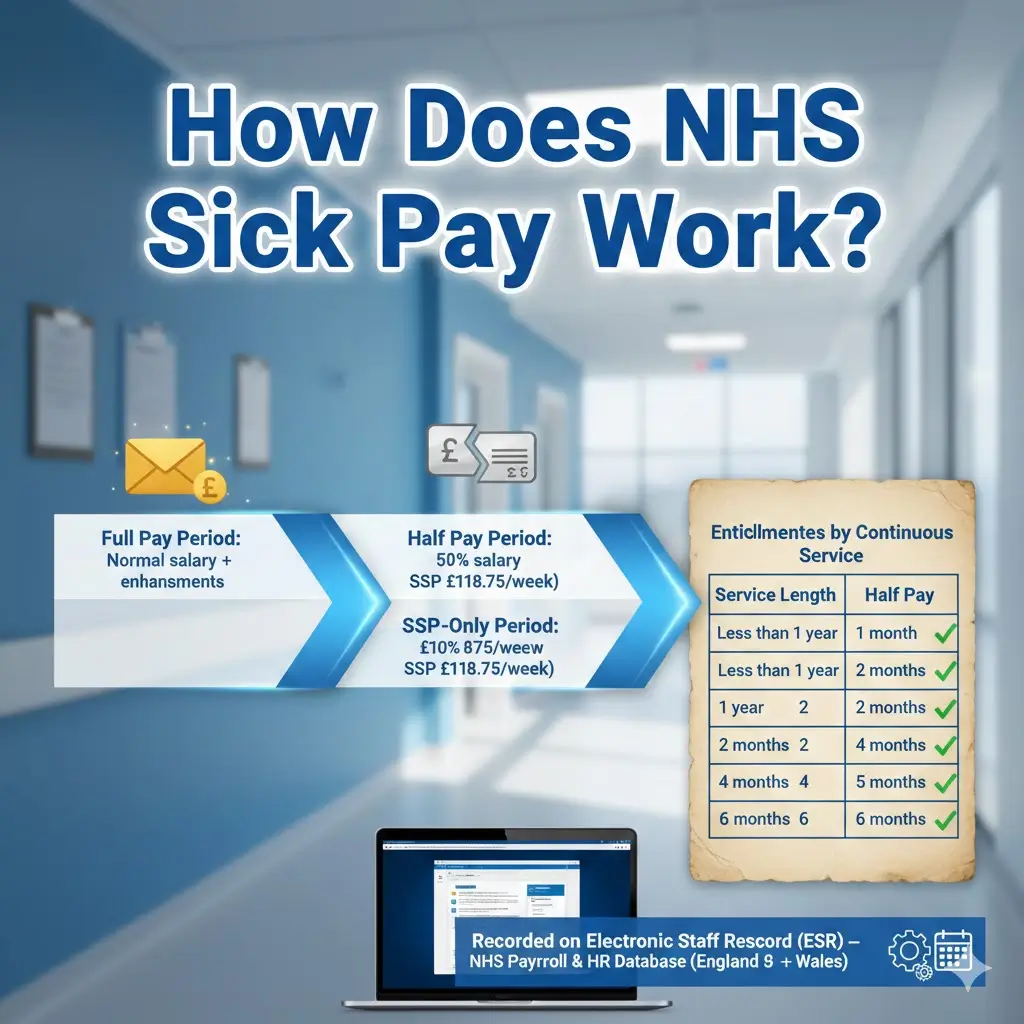
Your entitlement follows a structured progression:
-
- Full pay period — receive your normal salary, including enhancements
-
- Half pay period — receive 50% of salary (never below SSP rate)
-
- SSP-only period — £118.75 per week for up to 28 weeks
Sickness is recorded on the Electronic Staff Record (ESR), the NHS payroll and HR database used across all NHS Trusts in England and Wales.
NHS Sick Pay Entitlement Table 2025/26
Your sick pay allowance depends entirely on the length of service, not your pay band. Band 2 and Band 9 staff with identical service receive the same entitlement periods.
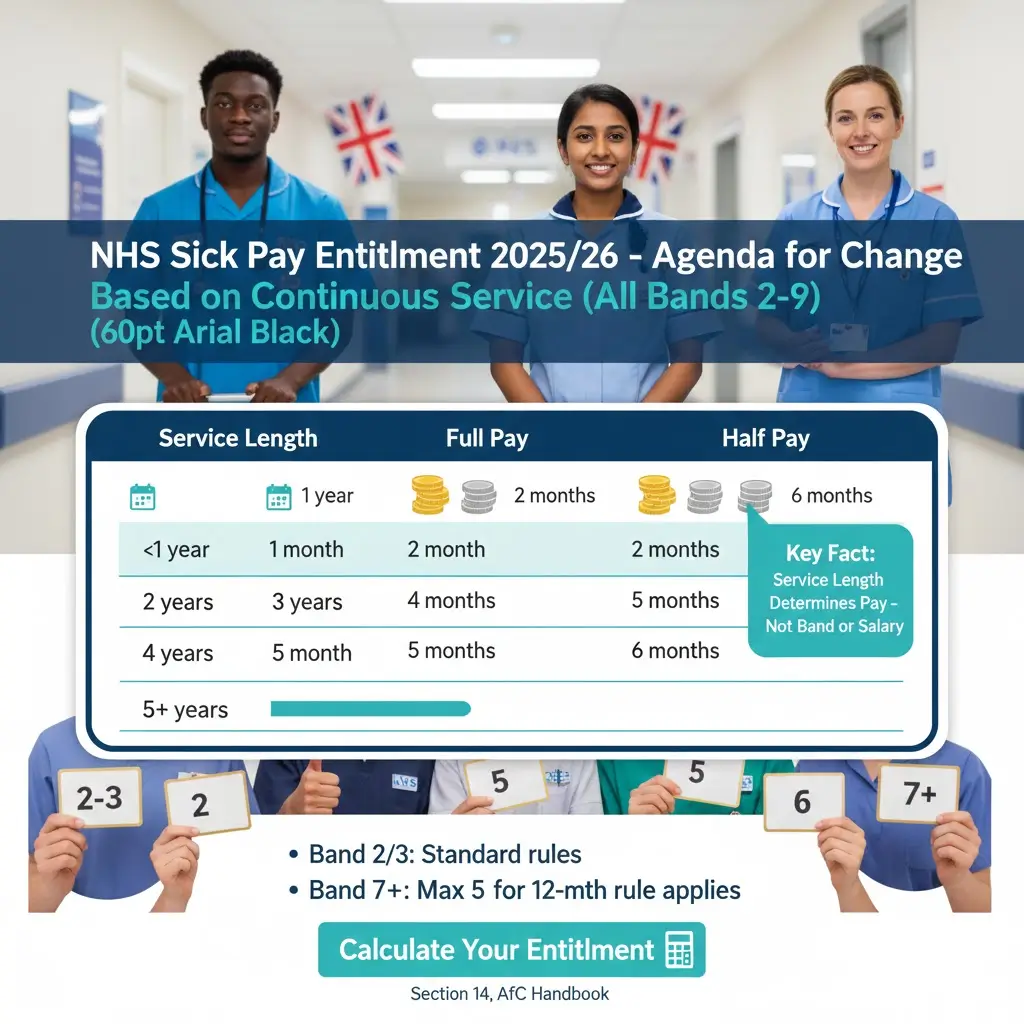
| Continuous NHS Service | Full Pay | Half Pay |
| Less than 1 year | 1 month | 1 month |
| 1 year | 1 month | 2 months |
| 2 years | 2 months | 2 months |
| 3 years | 4 months | 5 months |
| 4 years | 5 months | 5 months |
| 5+ years | 6 months | 6 months |
This structure applies to all Agenda for Change staff across NHS England, NHS Scotland, and NHS Wales. These entitlements are defined in Section 14 of the Agenda for Change handbook.
Read Guide: NHS Band 5 Pay 2025/26
NHS Sick Pay by Band (Band 2 to Band 9)
Band 2 NHS Sick Pay
Band 2 Healthcare Assistants, Support Workers, Porters, and Clerical Assistants receive the standard AfC sick pay entitlement. Their length of service — not pay band — determines their NHS full-pay and half-pay periods.
Short service staff (under 1 year) receive:
-
- 1 month full pay
-
- 1 month half pay
After 5+ years of continuous service:
-
- 6 months full pay
- 6 months half pay
Read Guide: NHS Band 2 Pay 2025/26
Band 3 NHS Sick Pay
Band 3 Senior Healthcare Assistants, Phlebotomists, and Therapy Assistants follow the same entitlement rules as Band 2. Differences in daily sick pay calculations come from higher hourly and annual salary rates. Part-time Band 3 staff receive pro-rated calculations based on contracted hours.
Read Guide: NHS Band 3 Pay 2025/26
Band 4 NHS Sick Pay
Band 4 Assistant Practitioners, Associate Practitioners, Nursing Associates, and Administrative Supervisors receive the same NHS sick pay entitlement based on service years. Band 4 staff with more than 2 years of service benefit significantly from increased full-pay allowances of 2 months.
Band 5 NHS Sick Pay
Band 5 Staff Nurses, Radiographers, Physiotherapists, Occupational Therapists, Dietitians, and Paramedics often have 3–5+ years of NHS service. Most Band 5 clinicians qualify for the maximum 6 months full pay plus 6 months half pay entitlement.
Example: A Band 5 Nurse with 3 years of service receives:
-
- Full Pay: 4 months
-
- Half Pay: 5 months
If sick for 8 weeks, the entire period is covered by full pay.
Read Guide: NHS Band 5 Pay 2025/26
Band 6 NHS Sick Pay
Band 6 Specialist Nurses, Senior Practitioners, Community Nurses, and Team Leaders usually have substantial service length. Part-time Band 6 staff receive entitlement calculated at their Whole Time Equivalent (WTE) fraction.
Read Guide: NHS Band 6 Pay 2025/26
Band 7 NHS Sick Pay
Band 7 Ward Managers, Clinical Leads, Advanced Nurse Practitioners, and Specialist Coordinators typically have 5+ years of service. The rolling 12-month rule significantly impacts Band 7 staff who have taken previous sickness absence within the past year.
Read Guide: NHS Band 7 Pay 2025/26
Band 8a and Band 8b NHS Sick Pay
Band 8a managers, matrons, and senior clinicians receive the same entitlement as lower bands but with significantly higher daily pay during full-pay phases.
Band 8b professionals — often senior managers, service leads, and consultant practitioners — follow identical sick pay rules. Sick pay amounts scale with salary, not band level.
Band 8c, Band 8d, and Band 9 NHS Sick Pay
Band 8c, Band 8d, and Band 9 director-level and executive roles follow the same AfC entitlement structure. Service length determines allowance periods, not seniority or salary grade.
How NHS Sick Pay Is Calculated
Full Pay Calculation
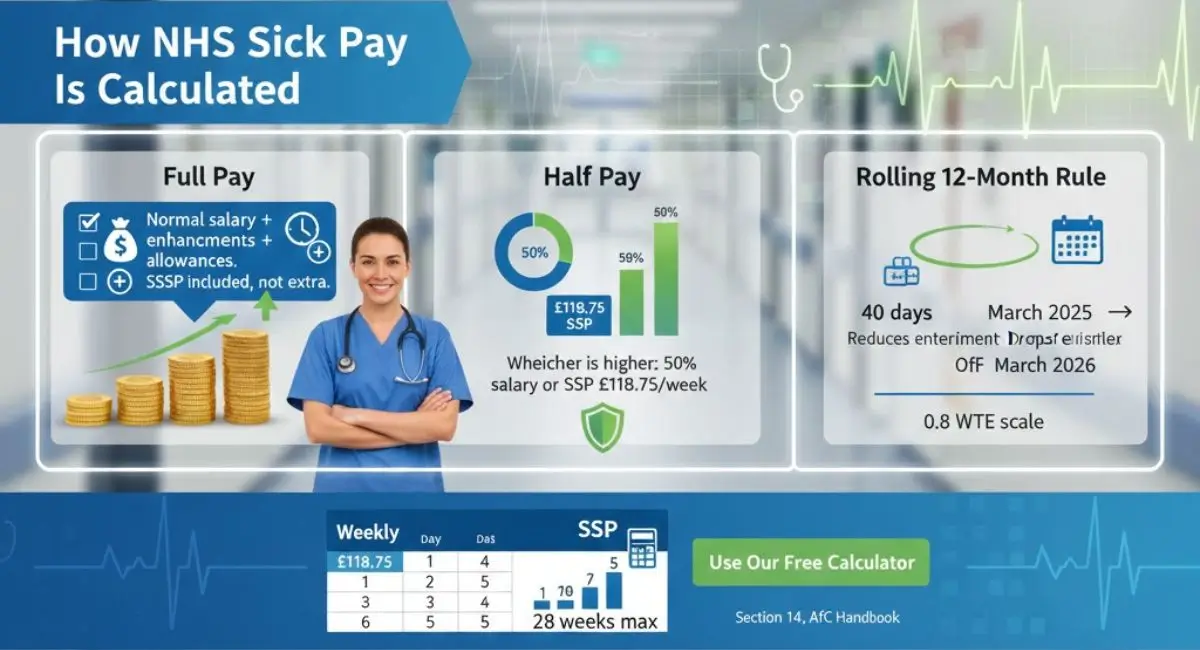
During full pay periods, you receive your normal salary, including:
-
- Basic pay
-
- Standard contractual enhancements
-
- High-cost area supplements (where applicable)
-
- Section 14 unsocial hours payments
-
- On-call allowances (if contractual)
SSP is included within NHS pay, not added on top.
Half Pay Calculation
During half-pay periods, you receive whichever is higher:
-
- 50% of your normal salary, or
-
- The SSP rate (£118.75 per week)
This protection ensures your income never falls below the statutory minimum during half pay periods.
Part-Time Worker Calculations
Part-time NHS staff receive entitlement pro-rated by contracted hours. A 0.8 WTE (30 hours per week) employee receives 80% of full-time equivalent pay during sick leave. The entitlement period remains the same — only the payment amount is adjusted.
The Rolling 12-Month Rule Explained
NHS sick pay entitlement is based on sickness taken in the past 365 days, not the calendar year.
How it affects you:
-
- Any sick leave in the past 12 months reduces available full pay and half pay
-
- Long-term absence quickly uses full-pay periods
-
- As the older sickness passes 12 months old, entitlement gradually restores
Rolling 12-Month Example
A Band 6 Specialist Nurse used 40 days’ sick pay in March 2025. When a new sickness occurs in November 2025, those 40 days reduce available full and half pay entitlement. In March 2026, those days drop off the rolling calculation and entitlementis fully restored.
This is why accurate NHS sick pay calculators must factor in previous sickness days — otherwise, results are inaccurate.
Statutory Sick Pay (SSP) Rates 2025/26
When NHS occupational sick pay ends, Statutory Sick Pay continues for up to 28 weeks.
| SSP Element | 2025/26 Rate |
| Weekly SSP | £118.75 |
| Lower Earnings Limit | £125 per week |
| Maximum duration | 28 weeks |
| Waiting days | First 3 qualifying days (unpaid) |
Source: GOV.UK SSP rates for 6 April 2025 to 5 April 2026.
SSP Daily Rates by Qualifying Days
| Qualifying Days per Week | Daily SSP Rate (Unrounded) |
| 7 days | £16.9642 |
| 6 days | £19.7916 |
| 5 days | £23.75 |
| 4 days | £29.6875 |
| 3 days | £39.5833 |
| 2 days | £59.375 |
| 1 day | £118.75 |
SSP Payment by Days Sick (5 Qualifying Days)
| Days to Pay | Amount Due |
| 1 day | £23.75 |
| 2 days | £47.50 |
| 3 days | £71.25 |
| 4 days | £95.00 |
| 5 days | £118.75 |
Period of Incapacity for Work (PIW)
A Period of Incapacity for Work is a sickness period lasting 4 days or more in a row. Understanding PIWs is essential for accurate calculations.
All days of sickness count towards the total number of days in a PIW, including:
-
- Bank holidays
-
- Weekends
-
- Non-working days
If the period of sickness is less than 4 days in a row, there is no PIW, and SSP does not apply.
The 8-Week Linking Rule
If the gap between PIWs is 8 weeks (56 days) or less, you must link them and treat them as one continuous PIW.
Key implications:
-
- If all 3 waiting days have not been used in the first PIW, use any remaining waiting days at the start of the next linked PIW
-
- Decide on entitlement to SSP by applying qualifying conditions to the first day of the first PIW
-
- If there is a gap of more than 56 days between sickness periods, the allowance resets, and you could be eligible for another 28 weeks of SSP
Linked PIW Example
An employee is sick for 5 days, returns to work, then falls sick again 6 weeks later. These two absences are linked as one PIW because the gap is under 8 weeks. The 3 waiting days apply only to the first absence — SSP begins immediately for the second absence.
NHS Sick Pay Worked Examples
Example 1: Band 3 Short Service
Situation:
-
- Role: Band 3 Senior Healthcare Assistant
-
- Service: 9 months continuous NHS service
-
- Salary: £25,500 (full-time)
-
- Previous sickness (last 12 months): 0 days
-
- Current sickness: 6 weeks (30 working days)
Entitlement: 1 month full pay + 1 month half pay
Outcome:
-
- First 4 weeks → Full pay
-
- Next 2 weeks → Half pay
-
- No SSP-only or unpaid period
Example 2: Band 4 With Previous Sickness
Situation:
-
- Role: Band 4 Assistant Practitioner
-
- Service: 2 years
-
- Salary: £29,000
-
- Previous sickness: 20 working days earlier in the year
-
- Current sickness: 8 weeks (40 working days)
Entitlement: 2 months full pay (≈43 working days) + 2 months half pay (≈43 working days)
Adjustment: 20 days already used from full pay, remaining full pay ≈ 23 days
Outcome:
-
- 23 days → Full pay
-
- 17 days → Half pay
-
- No SSP-only period
Example 3: Band 5 Long-Term Sickness
Situation:
-
- Role: Band 5 Staff Nurse
-
- Service: 5 years
-
- Salary: £33,487
-
- Previous sickness: 0 days
-
- Current sickness: 9 months of continuous absence
Entitlement: 6 months full pay + 6 months half pay
Outcome:
-
- Months 1–6 → Full pay
-
- Months 7–9 → Half pay
-
- SSP included within pay
-
- No unpaid period yet
Example 4: Band 6 Part-Time Worker
Situation:
-
- Role: Band 6 Specialist Nurse
-
- Service: 4 years
-
- Hours: 30 hours per week (0.8 WTE)
-
- Salary (FTE): £42,000
-
- Previous sickness: 0 days
-
- Current sickness: 12 weeks
Entitlement: 5 months full pay + 5 months half pay (pro-rated by hours)
Outcome:
-
- Entire absence covered by full pay
-
- Pay is calculated at 0.8 of the full-time salary
-
- Full entitlement remains partially unused
Example 5: Band 7 Rolling 12-Month Impact
Situation:
-
- Role: Band 7 Ward Manager
-
- Service: 6 years
-
- Salary: £52,000
-
- Previous sickness: 3 months of sickness 8 months ago
-
- New sickness: 10 weeks
Entitlement: 6 months full pay + 6 months half pay (total)
Adjustment: Only 3 months of full pay remain due to earlier absence
Outcome:
-
- First 3 months → Full pay
-
- Remaining weeks → Half pay
-
- No SSP-only period
SSP Calculation Examples
Full-Time Worker SSP Example
A full-time worker (Monday to Friday) was absent for a fortnight due to illness. This means they were unavailable for 10 shifts, 7 of which qualify after the 3 waiting days.
Calculation:
-
- Weekly SSP: £118.75
-
- Qualifying days per week: 5
-
- Daily rate: £118.75 ÷ 5 = £23.75
-
- Total SSP: £23.75 × 7 = £166.25
SSP Payment Examples Table
| Employee Works | Qualifying Days | Period of Sickness | Waiting Days | Days SSP Payable | Total Due |
| Monday to Friday | 5 | 5 days | 3 | 2 | £47.50 |
| Tue, Wed, Thu, Fri | 4 | 4 days | 3 | 1 | £29.69 |
| Tue, Thu, Fri | 3 | 3 days | 0 | 0 | £0.00 |
Working Out Average Weekly Earnings
SSP entitlement depends on your employee’s average weekly earnings in a relevant period. For the tax year 2025 to 2026, average weekly earnings must be £125 or more.
Average weekly earnings must include all earnings on which Class 1 National Insurance contributions are due, or would be due if the employee’s earnings were high enough.
The Relevant Period
-
- End: The last normal payday before the first complete day of sickness
-
- Start: The day after the last normal payday, at least 8 weeks before the end of the relevant period
Weekly Paid Employees
If the first full day of sickness was 12 June 2025 and payday is every Friday, the last payday before sickness was 6 June 2025. The payday is at least 8 weeks before is 11 April 2025. The relevant period is 12 April 2025 to 6 June 2025.
Add all earnings paid during this period and divide by 8 (weeks).
Monthly Paid Employees
If the first full day of sickness was 12 June 2025 and payday is the last day of each month, the last payday before sickness was 30 May 2025. The payday is at least 8 weeks before, which is 28 March 2025. The relevant period is 29 March 2025 to 30 May 2025.
Add all earnings, divide by 2 (months), multiply by 12, then divide by 52 to get the weekly average.
New Employees
Employees may not have worked long enough for the normal average weekly earnings rules to apply. When the PIW is before any earnings have been paid, use the employee’s contractual earnings to determine SSP eligibility.
Qualifying Days Explained
Qualifying days are the only days that you can pay SSP for or count as waiting days. These are the days that your employee normally works under their contract.
If you and your employee cannot agree the qualifying days, use one of the following:
-
- The days which you and your employee agree they are required to work under their contract
-
- A Wednesday, if there is no named day of work
-
- Every day of the week except those when none of the workforce are required to work
Special Circumstances
Pregnancy-Related Sickness
Sickness absence related to pregnancy is recorded separately and does not count towards your rolling 12-month entitlement calculation. Different protections apply under maternity discrimination legislation.
Section 22: Injury at Work
If your sickness results from a workplace injury, Section 22 of AfC provides enhanced protection. You may receive up to 85% of pay for an extended period, protecting income during work-related recovery.
Retire and Return Staff
NHS employees who retired and returned to service may have previous service counted towards sick pay entitlement. Breaks of 12 months or less typically preserve continuous service. Longer breaks usually reset the calculation — verify with your HR department.
Bank Staff (SSP Only)
NHS Bank workers without permanent contracts typically receive SSP only, not occupational sick pay. Eligibility requires earning at least £125 per week and being unable to work for 4+ consecutive days.
Agency Workers and Zero-Hours Contracts
Agency workers, casual workers, and zero-hours contract employees may be entitled to SSP as long as they meet the earnings threshold of £125 per week and have been sick for 4+ consecutive days.
What Happens When NHS Sick Pay Ends?
When occupational sick pay is exhausted, the following pathway applies:
-
- SSP continues for up to 28 weeks total (if not already exhausted)
-
- Employer issues SSP1 form when SSP ends
-
- Apply for Employment and Support Allowance (ESA) or Universal Credit
-
- Consider ill-health retirement using forms AW33E (tier 1) or AW240 (tier 2) through the NHS Pension Scheme
NHS Sick Pay Documentation Requirements
| Absence Duration | Documentation Required |
| Days 1–7 | Self-certification |
| Day 8 onwards | Fit note (Statement of Fitness for Work) from GP |
| Extended absence | Regular fit notes and occupational health review |
Your employee must tell you they are sick within your own time limit (or 7 days if you do not have one).
Frequently Asked Questions
How are waiting days calculated?
The first 3 qualifying days of a Period of Incapacity for Work are unpaid waiting days. SSP begins from day 4. Waiting days are not always the first 3 days of sickness absence — they must be qualifying days (days you normally work). For example, if you fall sick on a Saturday, the weekend does not count as waiting days unless you normally work weekends.
What is a Period of Incapacity for Work (PIW)?
A PIW is a period of sickness lasting 4 days or more in a row, including weekends, bank holidays, and non-working days. If your sickness lasts less than 4 consecutive days, there is no PIW, and SSP does not apply.
How do linked periods of sickness work?
If the gap between PIWs is 8 weeks (56 days) or less, they are linked and treated as one continuous PIW. Waiting days only apply once to the first PIW. If all 3 waiting days were not used in the first PIW, the remaining waiting days apply to the start of the next linked PIW.
Can I get sick pay if I retire and return to the NHS?
Previous service may count if your break was 12 months or less. Longer breaks typically reset your entitlement calculation. Verify your continuous service with your HR department or check your Electronic Staff Record (ESR).
What is the NHS Injury Allowance?
If your illness or injury was caused by your work, you may qualify for NHS Injury Allowance under Section 22 of the Agenda for Change handbook. This can top up your sick pay to 85% of your normal earnings for up to 12 months. You must apply and meet specific criteria.
What happens when my 28 weeks of SSP end?
Your employer must send you form SSP1 when your SSP ends. You can use this form to apply for Employment and Support Allowance (ESA) or Universal Credit. If you cannot return to work, you may also consider ill-health retirement through the NHS Pension Scheme.
Do I need a fit note for sickness absence?
For absences of 7 days or less, you can self-certify your sickness. From day 8 onwards, you need a fit note (Statement of Fitness for Work) from a GP, hospital doctor, registered nurse, occupational therapist, pharmacist, or physiotherapist. The fit note can be printed or digital.
Can agency workers and zero-hours contract staff get sick pay?
Yes. Agency workers, casual workers, and zero-hours contract employees are entitled to SSP if they earn at least £125 per week on average and have been sick for 4+ consecutive days. You should identify your qualifying days based on your regular working pattern.
Key Takeaways of NHS Sick Pay Calculator
-
- NHS sick pay depends on service length, not pay band
-
- All bands (Band 2–Band 9) follow an identical entitlement structure
-
- 3 years of service provides 4 months full pay + 5 months half pay
-
- 5+ years of service provides a maximum 6 months full pay + 6 months half pay
-
- Half pay never falls below the SSP minimum of £118.75 per week
-
- Entitlement is based on a rolling 12-month period
-
- Previous sickness reduces available full-pay and half-pay days
-
- SSP continues for up to 28 weeks after occupational pay ends
-
- The first 3 qualifying days are unpaid waiting days
-
- Linked PIWs within 8 weeks (56 days) are treated as one period
-
- Part-time staff receive pro-rated calculations based on contracted hours
-
- Sickness is recorded on the Electronic Staff Record (ESR)
-
- Section 22 Injury Allowance can provide up to 85% of earnings
-
- Fit notes required from day 8 of sickness absence
Source: Agenda for Change Handbook, Section 14 | GOV.UK SSP Guidance | NHS Employers
Last Updated: January 2026 | Source: Agenda for Change Handbook, Section 14 & GOV.UK